English
 العربية
 русский
 Español
 français
 português
 Deutsch
 italiano
 Türkçe
 한국어
한국어 日本語
日本語
The plastic recycling industry is unforgiving to subpar equipment. From our experience, relying on mismatched or underpowered machinery is the fastest way to cripple your throughput and degrade your final pellet quality. As sustainability mandates tighten globally, merely grinding up scrap is no longer sufficient. Producing high-grade, market-ready recycled resin requires a strictly engineered, continuous processing line.
At Xjgmachine, we witness facility managers waste hundreds of thousands of dollars on bottlenecks because they misunderstand the specific functions of the machines used to recycle plastic. Whether you are dealing with heavily contaminated post-consumer agricultural films or clean post-industrial pipe purges, integrating the correct sequence of reduction, washing, and extrusion machinery dictates your ultimate profitability. This guide strips away the marketing fluff and details exactly what equipment you need, how it integrates, and whether it is actually worth buying for your specific application.
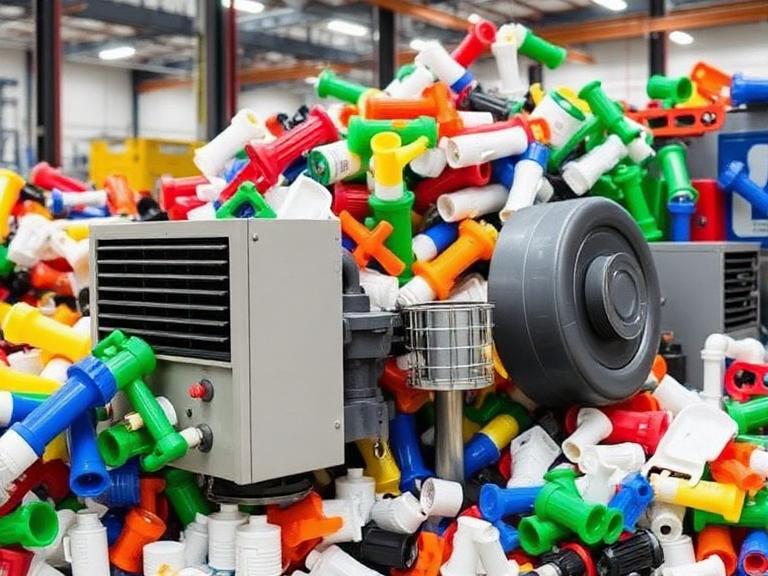
Quick Answer: What Are the Core Machines Used to Recycle Plastic?
A complete industrial plastic recycling line typically relies on 10 core machines functioning in strict sequence:
Shredder: Primary reduction of bulky, hard plastics.
Crusher (Granulator): Secondary reduction into uniform flakes.
Friction Washer: High-speed mechanical scrubbing to remove surface dirt.
Sink-Float Tank: Density-based separation of mixed polymers (e.g., PET from PP).
Hot Washer: Thermal and chemical removal of oils, glues, and labels.
Centrifugal Dryer: Rapid moisture extraction via high-RPM spinning.
Agglomerator (Densifier): Friction-heats lightweight films into dense granules for easier feeding.
Extruder: Melts, homogenizes, and filters the cleaned plastic.
Pelletizer: Cuts the extruded melt into uniform, sellable pellets.
Pulverizer: Grinds pellets or flakes into ultra-fine powders for specialized manufacturing.
Our Expert Recommendation: Do not piece together a frankenstein recycling line from a dozen different vendors. For commercial users aiming for maximum uptime, invest in an integrated Plastic Recycling Machine system where the throughput capacities of the shredder, washing line, and extruder are mathematically synchronized to prevent bottlenecks.
Table of Contents
What It Is and How the Recycling Workflow Operates
To understand the machines used to recycle plastic, you must first understand the workflow. Plastic recycling is essentially a purification and phase-change process. The objective is to take a heterogeneous, contaminated waste stream, break it down physically, strip away non-polymer contaminants chemically and mechanically, and then melt it down to filter out the microscopic impurities.
In most professional situations, a breakdown in the washing phase ruins the extrusion phase. If moisture is not properly extracted by the dryer, the extruder will suffer from foaming and inconsistent melt pressures. If the sink-float tank fails to separate PVC from PET, the resulting pellets will become brittle and useless. Understanding how these ten machines interact is the key to running a profitable plant.
Deep Dive: The 10 Common Machines Used to Recycle Plastic
1. Plastic Shredder
The plastic shredder is the heavy-duty gatekeeper of your facility. Operating at low speeds with extreme torque, single, double, or four-shaft shredders physically tear apart massive, thick-walled items like chemical drums, massive purges, and automotive bumpers. You cannot feed these bulky items directly into a granulator without stalling the motor or shattering the blades.
2. Plastic Crusher (Granulator)
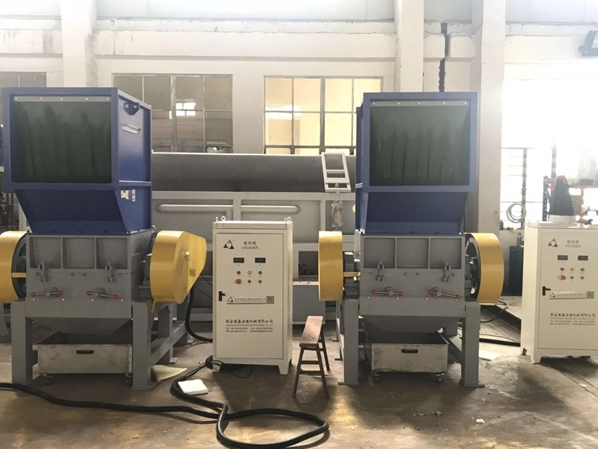
Once the shredder has reduced the bulk, the Plastic Crusher takes over. Operating at high RPMs with razor-sharp rotary blades, the crusher shears the plastic against stationary bed knives until the fragments are small enough to pass through a sizing screen. This machine produces the uniform "flake" required for effective washing. From our experience, keeping crusher blades meticulously sharp is the single most important maintenance task for preventing excess dust generation.
3. High-Speed Friction Washer
The friction washer is an inclined cylindrical machine featuring a high-speed rotor. Water is injected while the rotor spins the plastic flakes against a mesh screen at over 1,000 RPM. This aggressive mechanical action scrubs away loose dirt, sand, and paper labels.
4. Sink-Float Separation Tank
This is a long, water-filled trough that relies on fluid dynamics and material density. Because water has a density of 1 g/cm³, polymers heavier than water (like PET and PVC) will sink to the bottom, where a screw conveyor extracts them. Polymers lighter than water (like PE and PP) float and are paddled off the top. This machine is vital for purifying mixed waste streams.
5. Hot Washing Tank
For heavily soiled materials or post-consumer bottles covered in glues and oils, mechanical friction is not enough. The hot washer introduces water heated to 85°C–90°C mixed with caustic soda (sodium hydroxide) and detergents. This step dissolves stubborn adhesives and sterilizes the plastic flakes, raising the market value of the end product significantly.
6. Centrifugal Dryer (Dehydrator)
Moisture is the enemy of the extrusion process. The centrifugal dryer operates like an industrial spin-dryer, forcing the wet flakes against a perforated screen at extreme speeds to mechanically fling the water away. For heavy-duty applications, a secondary thermal air dryer is often added to drop moisture levels below 1%.
7. Agglomerator (Densifier)
If you recycle lightweight films (like LDPE wrap or plastic bags), feeding them into an extruder is practically impossible—they simply float in the hopper. An agglomerator uses rapid friction to generate heat, bringing the film to its softening point. The operator then injects a splash of water, which shock-cools the plastic, causing it to contract into heavy, dense granules that are easily fed into an extruder.
8. Plastic Extruder
The extruder is the heart of the operation. Clean, dry flakes are gravity-fed into a heated barrel containing a rotating screw (single or twin configuration). The combination of thermal heat and mechanical shear melts the plastic into a viscous fluid. Crucially, the extruder features vacuum degassing zones to suck out volatile gases, and screen changers (melt filters) to trap microscopic impurities like aluminum flecks or unmelted wood fibers.
9. Pelletizer
As the purified melt exits the extruder die head, the pelletizer takes over. There are two main types: strand pelletizers (where strings of plastic are pulled through a water bath and chopped by a rotary cutter) and water-ring/underwater pelletizers (where blades cut the plastic flush against the die face under a stream of cooling water). This results in the uniform, lentil-sized pellets preferred by injection molders.
10. Plastic Pulverizer Machine
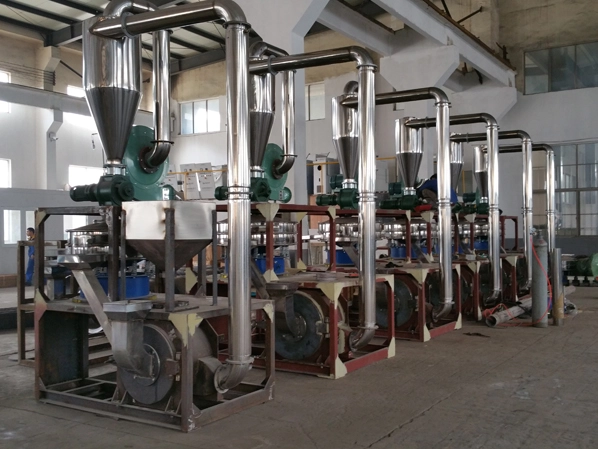
While pelletizing is the end of the line for most, some applications require ultra-fine powders. A Plastic Pulverizer Machine uses high-speed milling discs to grind pellets or clean flakes into micron-sized powder. This is highly recommended if you are creating raw material for rotational molding, masterbatch compounding, or specialized extrusions.
Quick Summary Table
| Machine Name | Primary Function | Workflow Stage |
|---|---|---|
| Shredder | Heavy-duty bulk size reduction | Initial Processing |
| Crusher (Granulator) | Secondary reduction to uniform flake | Initial Processing |
| Friction / Hot Washers | Mechanical and chemical decontamination | Washing & Purification |
| Sink-Float Tank | Density-based polymer separation | Washing & Purification |
| Agglomerator | Densifying lightweight films | Pre-Extrusion |
| Extruder & Pelletizer | Melting, filtering, and shaping into granules | Final Processing |
Benefits and Limitations of In-House Recycling
Many manufacturers debate whether to sell their plastic scrap to a third-party recycler or invest in their own machines used to recycle plastic. In our testing and financial modeling, establishing a closed-loop in-house system provides massive ROI, provided the facility generates enough volume.
| Pros of Integrating In-House Recycling Machinery | Cons / Limitations of In-House Setup |
|---|---|
| Dramatically reduces raw material resin procurement costs. | High initial capital expenditure (CapEx) for premium machinery. |
| Allows absolute control over the quality and purity of the recycled pellets. | Requires dedicated floor space and robust utility infrastructure (water, heavy power). |
| Eliminates waste disposal fees and transportation logistics for scrap. | Washing lines generate wastewater that requires compliant filtration and treatment systems. |
| Provides green credentials and supports corporate circular economy mandates. | Demands skilled operators for extruder temperature tuning and blade maintenance. |
Who Should Use It & Who Does Not Need It
For commercial users: If you are a packaging manufacturer, agricultural film producer, or manage a municipal recovery facility processing over 500 kg per hour, investing in a comprehensive recycling line is an absolute necessity. Furthermore, if you plan to feed this recycled material back into a high-end application—such as a HDPE Pipe Production Line—you must have full control over the melt flow index and purity of your pellets.
Who does not need it: Small injection molding shops generating a few dozen kilos of clean, unmixed runner scrap per day do not need a 10-machine washing and extrusion line. A simple beside-the-press grinder to instantly reintroduce the scrap into the hopper is highly sufficient and vastly more cost-effective.
Common Mistakes in Machine Selection
We routinely see buyers make catastrophic purchasing errors by misunderstanding material physics.
Skipping the Shredder: Feeding thick-walled pipe purges directly into a high-speed crusher will result in shattered blades and broken rotor shafts. You must step down the size using a shredder first.
Ignoring Moisture Content: Trying to extrude flakes that have not passed through an adequate centrifugal dryer will cause steam pockets in the extruder barrel, leading to brittle, hollow, and foaming pellets.
Improper Washing for High-End Goods: If you intend to use your recycled resin to manufacture consumer-facing items or delicate profiles via a Plastic Straw Making Machine, failing to implement a hot washing stage will result in unacceptable odor, discoloration, and structural defects in the final product.
Buying Considerations and Cost-Benefit Analysis
When evaluating upgrading or building a new recycling line, your focus must remain on throughput synchronization and wear-part longevity. Cheap machinery utilizes mild steel for shredder blades and standard unhardened screws in the extruder. In most professional situations, abrasive materials (like plastics containing glass fibers or sand) will destroy unhardened equipment in weeks. Demand nitrided or bimetallic extruder screws, and D2 or SKD-11 tool steel for your crusher blades.
Comparison Table: Shredders vs. Crushers
The most common point of confusion for beginners is the difference between primary and secondary size reduction.
| Feature | Plastic Shredder | Plastic Crusher (Granulator) |
|---|---|---|
| Speed (RPM) | Low (Typically 30 - 100 RPM) | High (Typically 400 - 800 RPM) |
| Torque | Extremely High | Moderate |
| Primary Target | Thick, bulky, hard-to-break blocks and pipes | Pre-shredded pieces, bottles, and thin-walled scrap |
| Output Size | Coarse strips or large chunks (40mm - 100mm) | Fine, uniform flakes (10mm - 20mm) |
Buying Guide Table: Matching Machine to Feedstock
| Input Material (Feedstock) | Critical Machinery Required (Beyond Basics) | Reasoning |
|---|---|---|
| Post-Consumer PET Bottles | Hot Washing Tank & Sink-Float Tank | Must remove aggressive glues and separate sinking PET from floating PP/HDPE bottle caps. |
| Agricultural LDPE Films | Agglomerator / Densifier | Films are too lightweight to enter the extruder throat natively; must be friction-densified first. |
| Thick-Walled PVC/HDPE Pipes | Heavy-Duty Single Shaft Shredder | Requires immense torque to break down pipe walls before standard crushing can occur. |
| Clean Post-Industrial Scrap | Extruder & Pelletizer Only | If the material is already clean and size-reduced, washing lines are a waste of capital. |
The Bottom Line
Navigating the machines used to recycle plastic does not have to be a guessing game. It is a strictly engineered process of size reduction, intense decontamination, moisture removal, and thermal reformation. Whether upgrading an existing line or building a facility from scratch, success hinges on material handling and component synchronization. Cutting corners on the washing phase guarantees poor pellet quality, while under-sizing your shredder ensures continuous maintenance downtime. We highly recommend consulting with a dedicated manufacturer like Xjgmachine to design a customized, closed-loop processing system that turns your specific plastic waste directly into high-value, market-ready resin.
Frequently Asked Questions
In most professional situations, a single-screw extruder is standard for recycling clean, consistent materials like washed PET or PE flakes due to its simplicity and lower maintenance cost. A twin-screw extruder provides superior mixing, higher shear, and better degassing capabilities, making it ideal for compounding recycled plastics with additives, colorants, or fillers.
Air bubbles (foaming) in final pellets are almost always caused by excessive moisture in the flakes entering the extruder. If the centrifugal dryer fails to drop moisture levels below 1-2%, the water turns to steam inside the heated extruder barrel, creating voids in the plastic. Upgrading your drying system or adding a vacuum degassing zone to the extruder will solve this.
Unless you possess a specialized force-feeding mechanism on your extruder hopper, you cannot skip the agglomerator for lightweight films. Without densification, plastic bags and films simply fluff up and bridge across the feed throat, starving the extruder screw and causing the machine to run dry and overheat.