English
 العربية
 русский
 Español
 français
 português
 Deutsch
 italiano
 Türkçe
 한국어
 日本語

Every plant manager, tooling director, and manufacturing engineer scaling up polymer production eventually confronts the critical question of process selection: should a component be molded, cast, machined, or continuously extruded? When your production target shifts from hundreds of discrete parts to thousands of linear meters of structural profiles, pressure conduits, medical tubing, or architectural thermal barriers, batch molding becomes a financial bottleneck. This is where thermoplastic extrusion commands absolute dominance. In the plastics processing industry, extrusion is the foundational workhorse, accounting for more than a third of all processed polymers globally. Yet walking into equipment procurement without practical machinery insight is a costly gamble. Too many operations invest in underpowered drives, miscalculated screw length-to-diameter (L/D) ratios, or mismatched barrel metallurgy, only to struggle with surging melt pressure, thermal degradation, and unmanageable scrap rates. As machinery engineers and extrusion line builders who design gearboxes, calculate polymer melt rheology, and balance downstream vacuum calibration tanks on factory floors daily, we provide an unvarnished, practitioner-level breakdown of thermoplastic extrusion. We explain the core physics, machine architecture, tooling realities, and commercial economics so you can configure and invest in extrusion lines that deliver high throughput, tight tolerances, and measurable profitability.
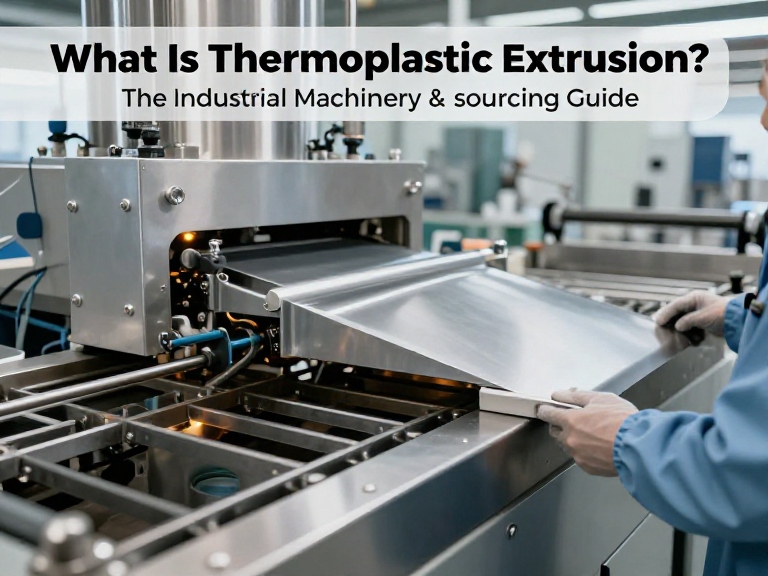
Quick Answer: What Is Thermoplastic Extrusion?
Thermoplastic extrusion is a continuous, high-volume manufacturing process in which solid polymer resin (pellets, flakes, or powders) is converted into a homogeneous, pressurized melt through mechanical shear and controlled external heat, then forced through a shaped steel orifice (die) to create continuous products with a fixed cross-sectional profile. As the molten plastic exits the die, it is immediately pulled through downstream calibrators, water-cooling baths, haul-off pullers, and flying cutters to achieve final dimensional tolerances. Unlike batch-oriented injection molding, thermoplastic extrusion operates uninterrupted 24/7, making it the most cost-effective method on Earth for producing pipes, window gaskets, structural channels, sheet stock, film, and insulated wire. For general polyolefin and technical profile processing, a reliable SJ Single Screw Extruder from Xjgmachine provides the optimal balance of energy efficiency, melt pressure stability, and capital ROI.
Article Directory
What It Is: The Fundamental Physics of Polymer Melting and Conveyance
Quick Summary Table: Key Parameters of Thermoplastic Extrusion
Direct Technical Comparison: Single Screw vs. Twin Screw vs. Injection Molding
Commercial Benefits vs. Operational Realities on the Plant Floor
Who Should Invest in Extrusion Lines vs. Who Needs Alternative Processes
Essential Sourcing Checklist: Auditing an Extruder Manufacturer
What It Is: The Fundamental Physics of Polymer Melting and Conveyance
To master thermoplastic extrusion, you must understand the distinction between thermosoftening plastics and thermosetting polymers. A thermoplastic consists of linear or branched macromolecular chains held together by secondary intermolecular forces (van der Waals interactions and hydrogen bonds) rather than permanent covalent crosslinks. When heated above its glass transition temperature ($T_g$) for amorphous polymers (like PVC or PMMA), or its crystalline melting point ($T_m$) for semi-crystalline polymers (like HDPE, PP, or PA66), the secondary bonds weaken, allowing polymer chains to slip past one another under shear stress. This process is fully reversible: the plastic can be melted, pressurized, shaped, cooled into a solid, and subsequently re-melted via a Plastic Recycling Machine without breaking the primary chemical backbone.
The extrusion process itself does not rely primarily on external heater bands to melt the plastic. In most professional situations, between 70% and 85% of the thermal energy required to plasticize the resin is generated internally through viscous dissipation (mechanical shear heat). As the flighted steel screw rotates inside the barrel, polymer pellets are wedged into an increasingly restricted channel depth. The intense frictional shearing between the polymer particles, the screw flights, and the barrel wall generates viscous shear heating. The external electric heater bands (ceramic or cast aluminum) serve primarily to initiate startup melting and fine-tune barrel zone temperatures.
From an engineering standpoint, an extruder functions as an Archimedean positive-displacement pump fighting dynamic backpressure. The system dynamics are dictated by three core geometric parameters:
Length-to-Diameter Ratio (L/D Ratio): The ratio of the flighted length of the screw to its outer diameter (typically ranging from 25:1 to 38:1 in modern industrial lines). A higher L/D ratio increases residence time, improves thermal homogeneity, and allows for superior additive dispersion and devolatilization.
Compression Ratio (CR): The ratio of the flight channel volume in the feed section to that in the metering section (typically 2.0:1 to 3.5:1). This mechanical compaction forces trapped air backward out through the hopper, consolidating the pellets into a solid, void-free melt pool.
Melt Flow Index (MFI) & Viscosity: Extrusion resins require higher molecular weights and lower melt flow rates (typically MFI < 2.0 g/10 min under standard ISO/ASTM test loads) than injection molding resins. Higher melt strength is mandatory to prevent the molten profile from sagging or collapsing under gravity between the die exit and the cooling calibrator.
Quick Summary Table: Key Parameters of Thermoplastic Extrusion
| Technical Parameter | Standard Range | Engineering Significance | Operational Failure if Miscalculated |
|---|---|---|---|
| Screw L/D Ratio | 25:1 to 36:1 (Commodity) 30:1 to 38:1+ (Technical) | Dictates residence time, mixing quality, and melting efficiency | Unmelted resin specks (too short) or thermal degradation (too long) |
| Compression Ratio (CR) | 2.0:1 (PVC / Thermal) 3.0:1 to 3.5:1 (Polyolefins) | Controls volumetric compaction, air purging, and pressure buildup | Air voids/porosity in melt (low CR) or excessive motor torque trips (high CR) |
| Barrel Temperature Zones | 150°C – 320°C (Polymer dependent) | Establishes controlled progressive temperature gradient from feed to die | Feed throat bridging (throat too hot) or screw seizure (barrel too cold) |
| Head Pressure (Die Entrance) | 100 – 350 bar (1,450 – 5,000+ PSI) | Ensures melt compaction, screen pack filtration, and uniform die flow | Poor wall thickness consistency, surging, or blown breaker plates |
| Linear Line Speed | 1 m/min (Heavy pipe) Up to 500+ m/min (Thin wire/blown film) | Governed by downstream cooling capacity and puller traction | Profile deformation, internal residual thermal stress, ovality defects |
How It Works: The 6 Discrete Stages of an Extrusion Line
A continuous thermoplastic extrusion production line operates as an unbroken synchronized chain of mechanical and thermodynamic events. If any single unit in the train experiences speed oscillation or thermal drift, the final product drifts out of dimensional tolerance.
Material Dosing and Feed Throat Conveyance: Virgin polymer pellets, masterbatch colorants, and recycled regrind are gravimetrically or volumetrically dosed from an overhead hopper into the water-cooled feed throat. The feed section must be kept cool (typically below 50°C) via circulating chillers to prevent pellets from prematurely softening and sticking together, which causes a complete feed stoppage known as "bridging."
Plasticization Along the Screw Flight Zones: Once inside the barrel, the rotating screw conveys the material across three classic zones:
Feed Zone: Deep flights move the solid bed forward through friction against the barrel wall.
Transition (Compression) Zone: The flight depth tapers shallower, compacting the resin against the heated barrel wall, generating intense shear, and forcing entrapped gases backward out of the hopper or through an optional vacuum degassing port.
Metering Zone: Shallow, constant-depth flights deliver high shear to homogenize melt temperature, stabilize pressure, and deliver a consistent volumetric flow rate into the die adapter.
Melt Filtration and Homogenization (Breaker Plate & Screen Changer): Before entering the die, the pressurized melt passes through a perforated steel breaker plate fitted with stainless steel wire mesh screens (screen packs ranging from 20 to 120 mesh). The breaker plate serves two functions: it filters out unmelted resin gels and foreign contaminants, and it converts the rotational swirling motion imparted by the screw into smooth, linear axial flow. High-throughput lines deploy continuous hydraulic or backflush screen changers to swap clogged filters without stopping line production.
Die Head Tooling and Extrudate Shaping: The molten polymer enters the custom-machined extrusion die head. The internal flow channels are designed using finite element analysis (FEA) to balance flow velocity across the entire cross-section. For circular pipes, the melt flows around an internal torpedo mandrel. For complex window profiles or a PA66 GF25 Polyamide Profile Thermal Break Strip Extrusion Line, the die channels route the polymer through precise restrictive lands that account for post-die polymer swell (elastic memory expansion).
Vacuum Sizing, Calibration, and Thermal Quenching: The moment the plastic leaves the hot die, it has zero structural rigidity. It immediately enters a vacuum sizing tank. An internal bronze or stainless steel vacuum calibrator sleeve holds the hot outer profile skin against its machined walls via differential vacuum pressure, while high-velocity water spray nozzles quench the plastic below its solidification temperature. Precise vacuum levels and water temperatures prevent sink marks, wall collapse, and thermal warping. Specialized systems like the PE/PP/PVC Warm Edge Spacer Bar Extrusion Line integrate micro-calibration tools to hold sub-millimeter tolerances on hollow profiles.
Haul-Off Traction, In-Line Printing, and Downstream Cut-to-Length: A continuous caterpillar track or rubber belt puller (haul-off unit) clamps the solidified profile and draws it steadily through the cooling tanks. The haul-off drive must be electronically synchronized with the extruder screw drive down to fractional RPMs; any speed mismatch stretches the profile thin or bunches it up in the calibrator. As the profile moves, an in-line Fiber Laser Printer marks lot numbers, specifications, and meter markers, before a pneumatic guillotine cutter, planetary saw, or coiler severs the profile into precise commercial lengths.
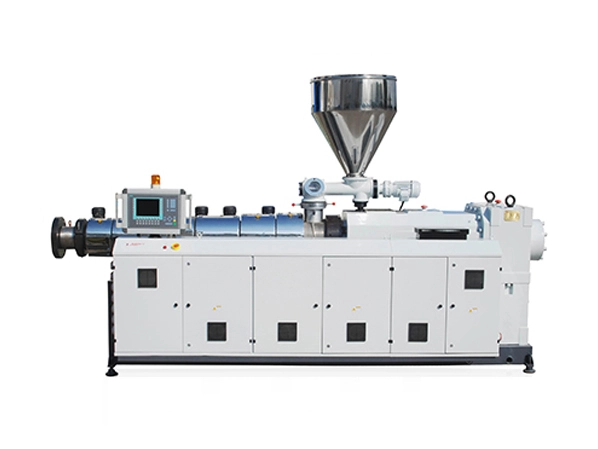
Machinery Spotlight: SJ Single Screw Extruder by Xjgmachine
When selecting core production machinery for high-output thermoplastic extrusion, the SJ Single Screw Extruder engineered by Xjgmachine represents the industrial benchmark for reliability, energy efficiency, and melt consistency across standard and engineering polymers.
| Extruder Category | Industrial High-Torque Single Screw Plastic Extruder |
| Material Versatility | Engineered for polyolefins (HDPE, LDPE, PP), polystyrene (PS), ABS, and technical thermoplastics |
| Screw Geometry | Application-specific customized screw profiles (barrier flights, pineapple/Maddock mixers) |
| Thermal Control | Multi-zone ceramic heater bands with high-volume, low-noise air-cooling blowers |
| Drive & Gearbox | High-torque hardened helical reduction gearbox with integrated heavy-duty thrust bearing assembly |
| Automation Level | Advanced PLC touchscreen integration with closed-loop pressure feedback and safety interlocks |
Engineering Recommendation: Single screw extrusion machines are widely used and suitable for processing general materials. The SJ Single Screw Extruder is our flagship plastic extrusion equipment. It is designed for efficient, reliable operation with superior temperature and pressure control, high automation, optimized screws for specific resins, lower maintenance, and higher production speeds. Explore complementary complete systems across our master Plastic Extruder catalog.
Direct Technical Comparison: Single Screw vs. Twin Screw vs. Injection Molding
| Evaluation Parameter | Single Screw Extrusion (e.g., SJ Series) | Twin Screw Extrusion (e.g., SJSZ Conical / Parallel) | High-Pressure Injection Molding |
|---|---|---|---|
| Process Dynamic | Continuous 24/7 linear output | Continuous 24/7 linear output | Discontinuous, cyclic batch process |
| Primary Product Geometry | Infinite 2D cross-sections (Pipes, profiles, sheets) | Compounded pellets, masterbatch, rigid PVC profiles | Discrete, complex 3D hollow/ribbed parts |
| Material Mixing & Shearing | Moderate (Relies on barrier/mixing pins) | Extreme (Intermeshing screws yield superior dispersive mixing) | Low-to-moderate (Basic plasticizing screw) |
| Handling Heat-Sensitive Resins | Moderate (Risk of shear burning on rigid PVC) | Superior (Gentle positive displacement in counter-rotating) | Poor (Subject to thermal degradation in runner gates) |
| Tooling Cost per Profile/Part | Low to Moderate ($1,500 – $8,000 per die set) | Moderate ($3,000 – $15,000 per complex die set) | Very High ($15,000 – $150,000+ per steel mold) |
| Scrap Generation & Recycling | Ultra-low (Steady-state startup scrap only; 100% regrindable) | Ultra-low (Direct in-line recycling compatibility) | Moderate (Runners, sprues, and rejected cycles) |
| Capital Equipment Cost | Cost-effective baseline ($$) | Moderate to High ($$$) | High to Extreme ($$$$) |
Pros and Cons of Thermoplastic Extrusion
| Evaluation Category | Industrial Advantages (Pros) | Operational Limitations & Challenges (Cons) |
|---|---|---|
| Production Economics |
|
|
| Product Performance |
|
|
Commercial Benefits vs. Operational Realities on the Plant Floor
Investing in thermoplastic extrusion lines requires sharp commercial judgment. Extrusion is an economy-of-scale game. Running an extrusion line for two hours to produce fifty meters of plastic pipe is an operational failure: the energy consumed to heat up three tons of steel barrel and die, coupled with the startup scrap generated while tuning the wall thickness, will destroy your margin.
The Real Commercial Advantages:
Unbeatable Cost-per-Kilogram Processing: Once an extrusion line reaches thermal equilibrium, it operates with minimal human intervention. A single operator can manage three continuous lines. For infrastructure projects, integrating a complete Plastic Pipe Production Line to manufacture agricultural irrigation or municipal conduit produces finished, marked pipe at direct resin-cost-plus-overhead margins that no distributor can undercut.
Multi-Layer Co-Extrusion Versatility: Modern tooling allows multiple extruders to feed a single die head. You can extrude a thick core of recycled regrind polymer encapsulated between virgin exterior and interior skins, slashing raw material costs by up to 40% while preserving pristine surface finish. Similarly, co-extrusion enables combining rigid PVC with flexible TPE sealing lips in a single pass.
Minimal Tooling Capital: Compared to complex multi-cavity injection molds with hot runners and hydraulic slide lifters that require six-figure investments, extrusion profile dies are wire-EDM cut from solid steel blocks. Tooling modifications and profile design adjustments can be executed in days at a fraction of the cost.
The Inherent Operational Constraints:
Geometric Inflexibility: An extruder cannot manufacture a closed container, a threaded bottle cap, or a three-dimensional housing. If your part features complex undercut tabs, non-linear walls, or variable thickness along its length, you must utilize injection molding, blow molding, or rotational casting.
The Die Swell Phenomenon: When long-chain polymer molecules travel through the restrictive land of a die, they are compressed like microscopic springs. The moment the extrudate exits the die into free air, those molecular springs relax, causing the material to expand in thickness and contract in length (die swell). Toolmakers must manually or algorithmically compensate for this viscoelastic memory when wire-cutting dies.
Thermal Momentum and Changeover Overhead: Heating an extruder barrel to 220°C takes 60 to 90 minutes. Purging a barrel from dark black HDPE to natural white PP consumes dozens of kilograms of purge compound and hours of non-productive downtime. Extrusion lines thrive on long, uninterrupted campaigns running single formulations.
Who Should Invest in Extrusion Lines vs. Who Needs Alternative Processes
Every equipment procurement budget must be allocated based on component geometry, order volume, and material chemistry. Knowing whether thermoplastic extrusion is the correct manufacturing pathway prevents catastrophic capital misallocation.
Operations That Must Invest in Thermoplastic Extrusion:
Pipe, Conduit, and Tubing Manufacturers: If you produce water supply lines, electrical conduit, gas distribution pipes, or large-diameter marine pipes, extrusion is the only viable method on Earth. Operations installing civil infrastructure rely on complete lines paired with on-site welding hardware like the HDPE Pipe Butt Welding Machine to deploy continuous joint-free pipelines over hundreds of kilometers.
Window, Door, and Architectural Profile Fabricators: Manufacturing rigid PVC window frames, commercial door weather-stripping, or structural thermal break profiles requires continuous tight-tolerance extrusion. Lines like the SJSZ Conical Twin Screw Extruder deliver the gentle, high-torque plasticization required to process dry-blend PVC powders with high calcium carbonate loading without burning the polymer.
Sheet, Film, and Packaging Converters: Producing food packaging films, geomembrane liners, plastic drinking straws with a specialized Plastic Straw Making Machine, or heavy sheet stock for thermoforming demands flat-die sheet extrusion lines.
Operations That Should Choose Alternative Manufacturing Processes:
Enclosed Automotive Tanks and Bottles: If you are producing hollow containers with small neck openings (like windshield washer fluid reservoirs or cosmetic bottles), you require extrusion blow molding (EBM) or stretch blow molding (SBM), where an extruded tube (parison) is clamped inside a mold and inflated with compressed air.
Discrete Multi-Axis Components: If your part is an electrical switch plate, an automotive gear, or a medical syringe body, you must utilize high-pressure injection molding.
Elastomeric Rubber Seals Requiring Vulcanization: While thermoplastics (TPE/TPV) can be extruded on standard machines, curing thermoset rubber compounds requires specialized crosslinking ovens found in a dedicated Rubber Extrusion Line or an EPDM Rubber Seal Strip/Profile Extrusion Line.
Costly Factory Floor Mistakes in Thermoplastic Extrusion
Plant Floor Engineering Advisory: The Feed Throat Bridging Hazard
The most common rookie mistake in extrusion operation is allowing cooling water flow to the feed throat to drop. If the water jacket temperature rises above the polymer softening point, incoming pellets melt prematurely in the hopper opening. The pellets fuse into an immovable solid plastic plug that stops screw intake completely. Clearing a bridged feed throat requires hours of downtime, manual torch heating, and chisel scraping, risking permanent damage to the precision barrel intake pocket.
Mismatched Screw Geometry for the Processed Resin: Using a general-purpose polyolefin screw to process rigid PVC or fiberglass-reinforced nylon is an operational disaster. Polyolefins require high-shear compression screws; rigid PVC is shear-sensitive and thermally unstable, releasing corrosive hydrochloric acid (HCl) gas if overheated, destroying standard barrels. Conversely, glass-filled engineering resins require hardened bimetallic barrels (tungsten carbide lining) and specialized low-compression flights to avoid fiber breakage and rapid barrel wear.
Neglecting Melt Pressure Transducer Calibration: Running an extrusion line without an active, calibrated melt pressure transducer directly upstream of the breaker plate is an extreme safety and quality hazard. The transducer acts as the line's heartbeat: if screen packs clog with contaminants, pressure can spike past 400 bar in seconds. Without automatic high-pressure drive shutdowns, operators risk bursting barrel heads, stripping gearboxes, or blowing molten polymer through flange seals.
Ignoring Hygroscopic Pre-Drying Requirements: Feeding wet polyamide (PA66), polycarbonate (PC), or PET into a standard extruder without prior desiccant hopper drying causes hydrolytic degradation. Water molecules chemically split the polymer chains at 250°C, permanently destroying the finished product's impact resistance and tensile strength, while turning the extrudate into a foamy, splay-riddled mess.
Operating with Poor Temperature Profiling: Setting a uniform, flat temperature across all barrel zones (e.g., 200°C across all five zones) demonstrates a lack of process understanding. An extrusion barrel must maintain a progressive thermal profile: cooler in the feed zone to establish solid bed conveyance, peaking in the transition zone to promote melting, and tapering slightly cooler in the metering zone to maintain melt strength and backpressure stability before entering the die.
Essential Sourcing Checklist: Auditing an Extruder Manufacturer
Before issuing a purchase order or signing a contract for an industrial thermoplastic extrusion line, require prospective machinery builders to verify compliance across these four non-negotiable engineering benchmarks:
1. Barrel Metallurgy and Nitriding / Bimetallic Specifications
Inquire about the steel grade used in the screw and barrel. Standard carbon steel will wash out within months. Insist on high-grade 38CrMoAlA alloy structural steel treated with gas nitriding to a depth of 0.5 to 0.8 mm, achieving a surface hardness of at least HV 900 to 1000. If processing abrasive materials (calcium carbonate fillers, glass fibers, or abrasive dredging components found in Dredging Products), mandate an upgraded centrifugal cast bimetallic alloy barrel with a tungsten carbide or nickel-based lining delivering hardness above HRC 60.
2. Gearbox Torque Rating and Thrust Bearing Capacity
The gearbox is the most expensive mechanical component on an extrusion machine. Ensure the manufacturer specifies a dedicated, heavy-duty helical reduction gearbox featuring high-torque ground gears (grade 6 precision) and an independent forced-oil lubrication cooling circuit. Settle for nothing less than a self-aligning spherical roller thrust bearing assembly rated with an L10 operational lifespan exceeding 50,000 hours under continuous maximum head pressure.
3. Closed-Loop Automation and Melt Instrumentation
Modern extrusion demands closed-loop digital process control. Settle for nothing less than an integrated industrial PLC system (Siemens, Omron, or Schneider) equipped with solid-state relays (SSRs) or Eurotherm temperature controllers. The system must feature automated melt pressure and melt temperature feedback, automatic screw/puller synchronization, safety interlock alarms, and Ethernet data logging for Industry 4.0 monitoring.
4. Total Downstream Line Integration
An extruder is only as good as its downstream sizing and pulling train. Verify that the machinery builder engineers the entire line as a cohesive system: matching vacuum pump CFM ratings to profile water-cooling volumes, sizing caterpillar haul-off pulling force to overcome vacuum tank drag, and integrating precision cut-off saws with optical sensors to deliver square, burr-free cuts.
Expert Machinery Verdict & Commissioning Roadmap
In our professional assessment across decades of manufacturing plant installations, thermoplastic extrusion remains the most profitable, resource-efficient polymer conversion technology ever engineered—provided you treat the machine as a precision instrument rather than a blunt instrument.
Here is your clear commercial action plan:
Define Your Material Rheology and Output Target: Establish your exact polymer grade, melt flow index, filler percentages, and required hourly output in kilograms. This calculation dictates your barrel diameter (from 45 mm up to 150 mm) and drive motor kilowatt sizing.
Select the Optimal Screw Architecture: For standard polyolefins, architectural profiles, and everyday technical extrusions, deploy a high-efficiency single screw platform like the SJ Single Screw Extruder. For shear-sensitive rigid PVC dry blends, invest in a conical twin screw system like the SJSZ Series.
Insist on Bimetallic Wear Protection: Do not save a few thousand dollars by purchasing non-nitrided or thin-nitrided steel barrels. The first time your operators run mineral-filled resin, cheap steel will wash out, ruining screw tolerances and destroying your melt pressure stability.
Partner with a Proven Turnkey Manufacturer: Partnering with an asset-backed manufacturer like Xjgmachine guarantees that your extrusion line arrives with matched mechanical engineering, robust gearboxes, optimized screw designs, and integrated downstream vacuum calibration, empowering your factory to extrude high-precision profiles with maximum uptime and lowest cost-per-meter margins.
Frequently Asked Questions
Thermoplastic extrusion is a continuous, high-volume polymer processing method where raw plastic pellets, granules, or powders are gravimetrically or volumetrically fed into a heated barrel, compacted and melted through mechanical shear and external thermal bands by a rotating screw, and continuously pumped under high pressure through an engineered shaping die to produce products with a constant cross-sectional geometry.
The primary difference lies in process continuity and product geometry. Thermoplastic extrusion is an uninterrupted, continuous process that produces open-ended, two-dimensional cross-sections of infinite length (such as pipes, profiles, sheets, and films). Injection molding is a discontinuous, cyclic batch process that injects molten polymer into closed, three-dimensional split mold cavities to create discrete, complex parts.
In most professional situations, single screw extruders are best for straightforward melting, pressure generation, and processing of standard polyolefins (PE, PP, PS). Twin screw extruders (especially counter-rotating conical or co-rotating parallel machines) are mandatory when processing heat-sensitive materials like rigid PVC formulations, performing masterbatch compounding, reactive polymer blending, or processing engineering polymers with high filler loadings.
Excess moisture in hygroscopic polymers (such as PA66, PET, or ABS) causes hydrolytic molecular chain scission at extrusion temperatures, severely degrading tensile strength. It also flashes into steam inside the metering zone or die head, causing cosmetic splay, foaming, internal voids, and diameter variations in the extruded profile. Proper pre-drying using desiccant dryers or vacuum-vented extrusion barrels is critical.