English
 العربية
 русский
 Español
 français
 português
 Deutsch
 italiano
 Türkçe
 한국어
 日本語

Every industrial entrepreneur, scrap trader, and environmental investor looking into the circular economy eventually discovers the immense commercial gap between public recycling slogans and actual factory floor reality. Enthusiasts view plastic recycling through the romanticized lens of environmental stewardship; experienced plant operators understand that it is a rigorous, high-torque materials manufacturing and bulk commodity trading business. If you purchase unvetted scrap bales, run dull granulator blades, or cross-contaminate a batch of high-density polyethylene (HDPE) with polypropylene (PP), your final product becomes valueless sludge that injection molders will instantly reject. Knowing how to start a plastic recycling business is not about collecting soda bottles in curbside bins; it is about engineering a repeatable, heavy-duty size reduction, de-contamination, and compounding line that converts erratic polymer waste into certified, high-purity regrind or uniform extrusion pellets. In our testing across industrial reclamation facilities and post-consumer washing plants, successful operations are built on strict polymer chemistry, robust mechanical cutting tolerances, and locked commercial off-take contracts. As recycling equipment manufacturers, heavy-duty shredder engineers, and extrusion specialists at Xjgmachine, we fabricate industrial granulators, commission automated film lines, and troubleshoot polymer processing lines worldwide. Here is our direct, unvarnished practitioner guide detailing the 6 critical steps to start a plastic recycling business that generates sustainable, high-margin industrial profitability from day one.
Quick Answer: How to Start a Plastic Recycling Business
To successfully start a plastic recycling business, execute six non-negotiable operational steps: (1) Select Your Target Polymer Stream & Secure Feedstock (focus initially on high-value, low-contamination post-industrial HDPE, PP, or clean LDPE film rather than mixed post-consumer waste); (2) Secure an Industrial Facility with 3-Phase Power & Water Permits (mandating minimum 400V/480V electrical service with 300kVA+ capacity and closed-loop wastewater settlement infrastructure); (3) Deploy Heavy-Duty Primary Size Reduction Machinery (installing high-torque shredders and precision-machined granulators like the Xjgmachine Plastic Crusher to achieve uniform 8mm–12mm flakes); (4) Integrate Washing, Density Separation & Mechanical Drying (utilizing sink-float tanks and centrifugal driers to drop contamination below 1% and moisture below 2%); (5) Implement Melt Filtration, Degassing & Compounding Pelletization (transforming low-bulk-density flakes into uniform pellets via single or twin-screw extruders equipped with continuous screen changers); and (6) Establish Quality Control Benchmarks & Secure Long-Term Off-Take Agreements (testing Melt Flow Index, density, and ash content to sign binding contracts with compounders and profile manufacturers). Bypassing cheap, undersized machinery and focusing on clean, single-stream polymers is the only way to safeguard your balance sheet.
Article Directory
The Economics of Plastic Reclamation: Understanding the Scrap-to-Resin Spread
Quick Summary Table: The 6 Steps to Launching a Recycling Plant
Step 2: Industrial Siting, Permitting, Power, and Water Loops
Step 3: Primary Size Reduction Line Selection (Shredders vs. Crushers)
Featured Equipment Spotlight: Xjgmachine Precision Plastic Crusher
Step 4: Density Separation, Friction Washing, and Drying Systems
Step 5: Melt Filtration, Degassing Extrusion, and Pelletization
Direct Technical Comparison: Regrind Flake vs. Compounded Pellet Operation
Pros and Cons: Launching an Industrial Plastic Recycling Enterprise
Essential Machinery Sourcing Checklist: Auditing Heavy-Duty Recycling Lines
Expert Industrial Verdict: The Commercial Scalability Blueprint
The Economics of Plastic Reclamation: Understanding the Scrap-to-Resin Spread
Before investing a single dollar in heavy industrial cutting equipment, you must understand the financial mechanism that governs this industry. A plastic recycling plant does not make money by "being green"; it operates purely on the crack spread between the landed acquisition cost of raw plastic waste and the prevailing spot price of prime virgin polymer pellets.
Consider the core commercial balance sheet:
Feedstock Cost ($/Ton): What you pay local distribution centers, agricultural operations, or post-industrial injection molders for dirty bales, purge lumps, or sorted scrap.
Conversion Yield Factor (%): The percentage of usable plastic that survives the process. If a batch contains 15% moisture, 8% paper labels, and 2% dirt, your mass yield is only 75%. If you paid for 100 tons, you only have 75 tons of saleable polymer.
Operating Expense per Ton (OPEX): The combined cost of electricity (kWh per ton), wear-and-tear tooling (blade sharpening, screen replacements), water treatment chemicals, direct labor, and facility overhead.
Off-Take Value ($/Ton): The selling price of your clean regrind flake or finished compounded pellets to end-market manufacturers.
In most professional situations, recycled regrind flake sells at a 20% to 35% discount against prime virgin resin, while certified high-grade recycled pellets sell at a 10% to 20% discount. When virgin resin prices surge due to petrochemical feedstocks, recycled polymer margins expand dramatically. However, when oil prices drop, your margins compress. The only operations that survive downturns are those with modern, high-throughput automated machinery that minimizes labor and maintains near-zero contamination levels. Deploying automated systems built around an integrated Plastic Recycling Machine architecture guarantees low operating cost per kilogram, insulating your balance sheet from commodity market swings.
Quick Summary Table: The 6 Steps to Launching a Recycling Plant
| Operational Phase | Primary Action Item | Target Benchmark / Metric | Critical Machinery / Asset | Direct Business Risk Mitigated |
|---|---|---|---|---|
| Step 1: Feedstock Selection | Secure single-stream polymer contracts | Locked volume ≥ 50–100 Tons/Month | Logistics & bale storage yard | Feedstock starvation & cross-polymer ruin |
| Step 2: Plant Infrastructure | Site selection, permits & utility sizing | 3-Phase 400V/480V; ≥ 300–800 kVA | Closed-loop settling & filtration tanks | Electrical transformer brownouts & EPA fines |
| Step 3: Size Reduction | Primary shredding and granulating | Uniform 8mm – 12mm flake geometry | High-torque crusher & single-shaft shredder | Machine jamming, screen blinding & blade wear |
| Step 4: Washing & Drying | Decontamination & density sorting | Purity > 99%; Residual moisture < 2% | Friction washers, sink-float tanks, driers | Extruder gas bubbling & degraded polymer melt |
| Step 5: Pelletization | Degassing extrusion & die-face cutting | Uniform cylindrical/spherical pellets | Single/Twin screw extruder + screen changer | Low bulk density handling rejection by molders |
| Step 6: QC & Off-Take | Standardize MFI, ash, tensile specs | Signed 12-month supply agreements | Melt Flow Index (MFI) tester, ash furnace | Unsold inventory & product liability claims |
Step 1: Polymer Stream Selection and Feedstock Sourcing
The single most catastrophic mistake beginners make when planning to start a plastic recycling business is attempting to recycle "all plastic." There is no such thing as a universal recycling plant. Different polymers possess completely incompatible melt temperatures, chemical structures, and physical densities. If you introduce just 1% of Polyvinyl Chloride (PVC) into a batch of Polyethylene Terephthalate (PET), the PVC will degrade into corrosive hydrochloric acid gas at PET's 260°C processing temperature, destroying the extruder screw, blackening the melt, and releasing toxic fumes. Similarly, Polypropylene (PP) and High-Density Polyethylene (HDPE) cannot cross-fuse at a molecular level; blended together without costly chemical compatibilizers, the resulting molded plastic has zero impact resistance and shatters like glass.
From our experience on the factory floor, you must build your business around a single dedicated polymer category before considering diversification:
Rigid Polyolefins (HDPE & PP): The most resilient, high-margin entry point. Sources include injection-molded transport crates, chemical drums, 5-gallon paint pails, bottle caps, and thick pipe cutoffs. Rigid HDPE and PP shred cleanly, sink/float separate easily, wash with minimal water retention, and have insatiable demand from agricultural pipe and container molders.
Flexible Polyolefin Films (LDPE, LLDPE, BOPP): Sourced from commercial shrink wrap, pallet stretch films, agricultural greenhouse sheeting, and shopping bags. Film lines require specialized continuous washing lines like a dedicated LDPE BOPP Film Recycling and Washing Line equipped with squeeze driers or thermal agglomerators, as thin film will wrap around standard granulator shafts and choke normal extruders.
Engineering Polymers (ABS, PC, PA66): Sourced from electronic scrap (E-waste) and automotive manufacturing offcuts. Highly profitable per ton, but demands strict sorting and metal detection to remove threaded brass inserts and flame-retardant additives. If processing composite profiles, specialized lines like a PA66 GF25 Polyamide Profile Thermal Break Strip Extrusion Line require dedicated granulating setups due to abrasive glass fibers.
You must establish guaranteed feedstock supply agreements before buying machines. Contract directly with regional distribution centers, industrial manufacturing hubs, agricultural co-ops, and municipal materials recovery facilities (MRFs). Ensure your contracts define maximum allowable contamination thresholds (e.g., maximum 5% non-target material by weight) and dictate moisture penalties for open-yard baled storage.
Step 2: Industrial Siting, Permitting, Power, and Water Loops
Plastic recycling is a heavy industrial manufacturing operation. You cannot set up a commercial plant in a light-commercial retail park. Siting your plant requires evaluating three physical constraints: raw electrical power delivery, closed-loop industrial water treatment, and municipal environmental zoning.
Examine the operational requirements:
Electrical Service Infrastructure: Recycling machinery draws monumental electrical current. A modest line—incorporating a 45kW primary shredder, a 37kW granulator, an 18kW friction washer, a 15kW centrifugal drier, and a 90kW compounding extruder—demands an installed transformer capacity of at least 400 to 600 kVA running 3-phase 380V/480V power. Undersizing your incoming electrical drop will cause brownouts, trip circuit breakers under heavy cutter head loads, and trigger punitive peak-demand utility surcharges.
Closed-Loop Wastewater Treatment: If your plant processes dirty post-consumer waste, you will consume thousands of liters of wash water per hour. Discharging untreated plastic wash water containing soil, suspended polymer fines, and caustic detergents into municipal sewers is illegal and will prompt immediate environmental shutdown. You must install a closed-loop water treatment system comprising settling weirs, dissolved air flotation (DAF) units, sand filters, and automated pH adjustment dosing pumps. The water must recycle continuously through your wash line, with only filtered sludge cake hauled off for waste disposal.
Logistical Floor Layout: Sizing your building correctly is critical. An operational recycling facility requires at least 1,200 to 3,000 square meters (13,000 to 32,000 sq ft). Raw, un-processed plastic scrap has an extraordinarily low bulk density (often less than 50 kg/m³ for un-baled containers or film). You need high-bay warehouse clearance for bale staging, wide truck turning aprons for 40-foot shipping containers, and isolated concrete pads for high-vibration cutting machinery.
Step 3: Primary Size Reduction Line Selection (Shredders vs. Crushers)
Once raw material arrives at the processing floor, the initial mechanical challenge is size reduction: reducing massive, irregular plastic purges, tangled pipe walls, or crushed bales into uniform 8mm to 12mm flakes that downstream washing tanks and extruder feed throats can accept. In our testing, attempting to process large, dense scrap directly in a standard granulator is the number one cause of motor burnout and catastrophic blade chipping.
Industrial size reduction operates as a two-stage sequential system:
Primary Shredding (Low Speed, High Torque): For massive solid purges, large-diameter gas pipe, or tightly baled film, material enters a low-speed primary shredder. A heavy-duty Single Shaft Shredder utilizes a hydraulically driven ram to force the plastic against a slowly rotating rotor (typically 60 to 90 RPM) fitted with concave, rotatable four-way tool-steel cutters. The low speed tears through the thickest plastic blocks without thermal melting, reducing the scrap into rough 40mm to 80mm chunks. For tangled film, bulky automotive bumpers, or hollow containers, a high-capacity Double Shaft Shredder or specialized Horizontal Shredder shears the bulk without wrapping around the drive shaft.
Secondary Granulation / Crushing (High Speed, Precision Cutting): The shredded chunks or thin-walled scrap (like bottles, crates, and molded trays) feed directly into a high-speed Plastic Crusher / Granulator. Rotating at 400 to 600 RPM, scissor-configured rotor blades sweep against stationary bed knives with a tight 0.2mm to 0.3mm tolerance gap. The plastic is repeatedly sheared until it passes through a calibrated bottom screen (typically 8mm to 12mm holes). The resulting regrind flake has high bulk density, uniform geometry, and clean edges ready for chemical washing or direct compounding.
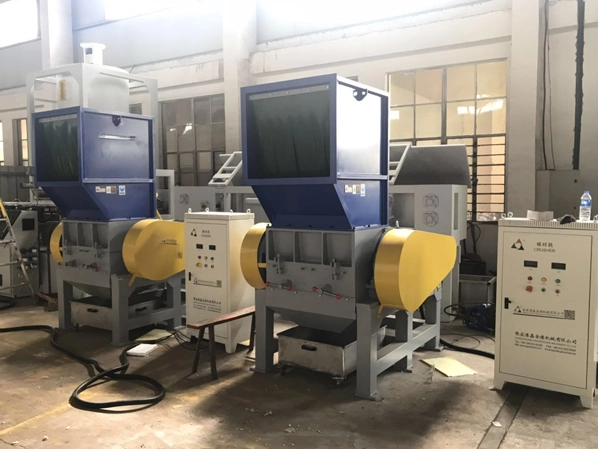
Industrial Machinery Spotlight: Xjgmachine Heavy-Duty Plastic Crusher
The beating heart of any mechanical recycling plant is the granulator. Built specifically to eliminate blade fractures, bearing contamination, and maintenance bottlenecks, the Xjgmachine Plastic Crusher is engineered for continuous, high-load industrial size reduction across rigid plastics, thick purge lumps, and abrasive composite scrap.
| Chassis Architecture | Single-cut solid steel plate blade frame delivering maximum structural rigidity, zero weld cracking, and vibration dampening |
| Safety Maintenance System | Hydraulic hopper opening paired with a mechanical Rotor Locking Device to protect maintenance personnel during blade swaps |
| Isolated Bearing Seats | External outboard bearing housings fitted with protective labyrinth seals to prevent wash water and abrasive plastic dust ingress |
| Screen Support Engineering | Heavy-duty lockable screen support frame maintaining exact geometric curvature to prevent screen blowouts and flake bypass |
| Discharge Flexibility | Equipped for standard pneumatic cyclone extraction or optional high-torque Screw Discharge Chute for sticky or dense regrind |
| Custom Glass-Fiber Hardfacing | Customizable specialized blade steel alloys (SKD-11 / D2) and tungsten carbide hardfacing tailored for abrasive glass-filled resins |
Plant Engineer's Sourcing Advice: Never buy a lightweight granulator fabricated from thin sheet metal. High-toughness plastic scrap will destroy light housings within three months. Review technical configurations directly on the official Plastic Crusher manufacturing page, or explore fine powder reduction setups via our Plastic Pulverizer Machine catalog.
Step 4: Density Separation, Friction Washing, and Drying Systems
Once your plastic is granulated into uniform 10mm flakes, you face the core operational challenge of contamination. Post-consumer and agricultural plastics arrive coated in road dirt, residual food sugars, motor oils, paper paper-pulp labels, and hot-melt adhesives. If these contaminants enter your extrusion line, they will carbonize, clog screen changers, emit toxic smoke, and leave the finished plastic brittle and porous.
An industrial wash line deploys four thermodynamic and physical separation stages:
High-Speed Friction Washing: Flakes enter a high-velocity horizontal auger spinning at 800 to 1,200 RPM inside a stainless-steel screen basket. High-pressure water jets spray continuously as the paddles violently rub plastic flakes against each other. The intense physical friction shears off surface paper labels, disintegrates dried organic soils, and strips water-soluble adhesives without damaging the polymer.
Sink-Float Density Separation Tanks: The washed slurry enters an elongated flotation separation tank. This process exploits the fundamental specific gravity ($SG$) differences of polymer groups:
Polyolefins (HDPE and PP): Have a density between 0.91 and 0.96 g/cm³, which is lighter than water ($1.0text{ g/cm³}$). Clean HDPE and PP flakes float effortlessly on the surface, where rotating paddle wheels sweep them forward into collection chutes.
Heavy Contaminants (PET, PVC, PS, Sand, and Metals): Have densities exceeding 1.15 to 1.45 g/cm³. They instantly sink to the bottom of the V-shaped tank, where an automated lower screw conveyor continuously purges the heavy waste from the system.
Centrifugal Mechanical Dewatering: Floating clean flakes exit the tank holding roughly 20% to 30% surface water. They drop into a vertical centrifugal spin-drier that spins flakes at high RPM, throwing moisture out through perforated screens and dropping residual surface water to under 2%.
Thermal Air Drying: For film or high-specification extrusion flakes, the regrind passes through hot-air pneumatic pipe ducts, dropping moisture below 0.5%. Trapped moisture inside an extruder barrel vaporizes into high-pressure steam, causing severe foaming, voids, and continuous strand breakage during pelletizing.
Step 5: Melt Filtration, Degassing Extrusion, and Pelletization
At this stage, you possess clean, dry regrind flake. While some manufacturers (such as injection molders of thick drainage sumps or outdoor pavers) can process raw flake directly, selling un-pelletized flake limits your market to low-tier buyers and leaves 30% to 40% of potential profit on the table. To capture premium pricing from automotive, pipe, and packaging manufacturers, you must convert the irregular flakes into uniform, compounded plastic pellets.
The extrusion pelletizing line must incorporate three critical technologies:
Forced Compaction & Feeding: Clean flake has a low, erratic bulk density that bridges easily in standard gravity feed hoppers. Industrial recycling extruders use a specialized integrated cutter-compactor drum or a dual-screw force-feeder that pre-heats, densifies, and continuously drives the light flake directly into the extruder screw flights without stalling.
Multi-Stage Vacuum Degassing (Devolatilization): Recycled plastics contain residual moisture, volatile printing ink solvents, and low-molecular-weight oligomers. The extruder barrel must feature at least two high-vacuum extraction zones (operating at ≥ -0.08 MPa). Powerful liquid-ring vacuum pumps suck volatile gases and steam out of the molten polymer pool before it reaches the die head, completely eliminating porosity, bubbling, and noxious odors from the final pellets.
Continuous Non-Stop Screen Changing: Even the cleanest washed plastic carries trace micro-particles, aluminum foil flecks, or foreign polymer fibers. The melt must pass through a heavy hydraulic screen changer fitted with dense mesh packs (typically 60 to 100 mesh). Elite lines utilize continuous back-flush screen changers that automatically purge dirty screens using high-pressure melt back-flow, allowing the line to run 24 hours a day without stopping the motor to swap filters.
Pelletizing Systems (Water-Ring vs. Strand vs. Underwater): For polyolefins (HDPE/PP), water-ring die-face pelletizers are the industry favorite: rotating knives cut the molten strands directly against the die face inside a mist of cooling water, flinging uniform spherical pellets into a dewatering sieve. For brittle polymers or masterbatches, continuous cold-water strand pelletizing lines provide razor-sharp cylindrical granules.
Step 6: Lab QC, Melt Flow Indexing, and Off-Take Contracts
The final, decisive step to start a plastic recycling business is transforming your factory from an unverified scrap processor into a certified, specification-grade raw material supplier. Industrial procurement managers at major compounding plants, rotomolders, and profile extrusion facilities will never sign long-term purchase orders based on verbal assurances. They require verified laboratory proof that your recycled pellets match their tight processing parameters.
You must invest in a basic in-house quality assurance laboratory equipped with four instruments:
Melt Flow Indexer (MFI / MFR): Governed by ASTM D1238 Standard Test Method for Melt Flow Rates of Thermoplastics. The MFI test measures how many grams of polymer flow through a calibrated orifice at a specific temperature and load over 10 minutes (e.g., 2.16 kg at 190°C for HDPE). Injection molders require high-MFI resin (10 to 30 g/10min) to fill complex multi-cavity molds; pipe extruders require low-MFI "fractional-melt" resin (0.2 to 0.8 g/10min) to prevent the hot extruded pipe from sagging under gravity before it reaches the cooling tank. If your recycled HDPE batch has an unstable, fluctuating MFI, it is industrially useless.
Moisture Analyzer (Halogen Loss-on-Drying): Verifies that residual pellet moisture sits strictly below 0.05% to 0.10%. Excess moisture creates catastrophic splay marks and structural voids during customer injection cycles.
Muffle Furnace Ash Content Tester: Burns a 5-gram sample of plastic at 600°C for two hours, vaporizing all organic polymer chains and leaving only inorganic residue (calcium carbonate filler, titanium dioxide pigment, silica dirt). Premium unfilled recycled pellets must maintain an ash content below 1.5% to 2.0%. High ash indicates dirty wash water or un-removed mineral fillers that degrade tensile properties.
Density Gradient Column / Pycnometer: Accurately measures the density of your polymer down to four decimal places (e.g., 0.9520 g/cm³), proving whether your product is pure virgin-equivalent HDPE or contaminated with lighter LDPE or heavier PP fractions.
With verified lab data sheets in hand, you can negotiate binding 12-month off-take supply agreements with regional pipe manufacturers, pallet molders, automotive sub-tier suppliers, and packaging firms. Many operations partner downstream with secondary processing lines—such as linking recycled resin directly into specialized building-product lines like a PE/PP/PVC Warm Edge Spacer Bar Extrusion Line or infrastructure fabrication equipment like a PVC Pipe Bending Machine and PVC Pipe Belling Machine—capturing maximum end-product margins internally.
Direct Technical Comparison: Regrind Flake vs. Compounded Pellet Operation
| Operational Parameter | Level 1: Shred & Regrind Flake Facility | Level 2: Full Washing & Pelletizing Plant | Level 3: Advanced Compounding & Upcycling Plant |
|---|---|---|---|
| Initial Capital Equipment Cost | $120,000 – $250,000 (Low barrier) | $450,000 – $1,200,000 (Industrial standard) | $1,500,000 – $3,500,000+ (High CAPEX) |
| Output Product Format | Raw 8mm–12mm chipped flakes | Uniform 3mm melted & degassed pellets | Modified, mineral-filled or impact-modified pellets |
| Target Customers | Secondary compounders, local budget molders | Mainstream injection and pipe extrusion plants | Tier-1 automotive, appliance, and packaging OEMs |
| Market Selling Price vs. Virgin | Sells at 35% – 50% discount to virgin | Sells at 15% – 25% discount to virgin | Sells at parity (or premium for circular compliance) |
| Gross Operating Margin Range | 12% – 18% (Vulnerable to scrap price spikes) | 22% – 35% (Robust, protected margins) | 35% – 50%+ (High technical value-add) |
| Electrical Power Requirement | 100 – 200 kVA (Standard industrial drop) | 400 – 800 kVA (Dedicated substation) | 800 – 1,500+ kVA (Heavy industrial utility) |
Pros and Cons: Launching an Industrial Plastic Recycling Enterprise
| Business Model Aspect | Documented Practical Advantages (Pros) | Real-World Industrial Liabilities (Cons) |
|---|---|---|
| Mechanical Plastic Recycling (Shredding, Washing, Pelletizing) |
|
|
| Scrap Brokering & Baling Only (Low-Tech Waste Trading) |
|
|
5 Fatal Mistakes New Recycling Operators Make
Factory Floor Advisory: The "Unprotected Tramp Metal" Catastrophe
The most expensive mechanical disaster in a plastic recycling plant is feeding a bale containing hidden tramp metal (steel bolts, rebar wire, or broken forklift tines) into a high-speed granulator. A single 10mm high-tensile steel bolt entering a granulator rotor spinning at 500 RPM will shatter D2 tool-steel blades in milliseconds, gouge the precision-machined cutting chamber, bend the main rotor shaft, and punch through the bottom screen cradle. The resulting catastrophic damage costs tens of thousands of dollars in replacement parts and shuts down the entire processing plant for weeks. Always install an over-belt electromagnetic separator followed by a high-sensitivity electronic tunnel metal detector on your primary feed conveyor before material ever reaches the cutting chamber.
Undersizing the Primary Cutting Drive Motors: Buying a budget granulator fitted with a 15kW motor to grind thick, solid HDPE purges or heavy automotive battery cases to save money on initial machinery quotes. Under heavy, dense scrap feeding, an undersized motor bogs down, stalls out, and trips thermal overload relays repeatedly. Granulators must be sized with massive, high-inertia solid steel flywheels and heavy-duty electric motors (37kW to 75kW+) capable of powering through high-resistance cutting jams without stalling.
Mixing Incompatible Polyolefin Grades: Blending blow-molding grade HDPE (from milk jugs and detergent bottles with an MFI of 0.3 to 0.7 g/10min) with injection-molding grade HDPE (from bottle caps and crates with an MFI of 4.0 to 10.0 g/10min). While both are chemically "HDPE," blending them produces an un-homogeneous, intermediate-MFI resin that satisfies neither blow molders nor injection molders. Sort your feedstock by processing manufacturing grade, not just generic resin recycling codes.
Ignoring Knife Clearance Maintenance Schedules: Running granulators for six months without sharpening blades or adjusting the knife clearance gap. As cutting edges dull, the granulator stops shearing cleanly; instead, it smashes, tears, and rubs the plastic against the screen. This mechanical friction generates excessive fines (unusable plastic dust), spikes electrical power consumption by up to 40%, and heats the cutting chamber until low-melting-point polymers (like LDPE) melt and gum up the rotor. Enforce weekly blade inspections and maintain a razor-sharp 0.20mm to 0.30mm knife clearance gap.
Overlooking Volatile Devolatilization in Extruder Barrels: Attempting to pelletize printed post-consumer packaging film using an un-vented, solid-barrel single-screw extruder. As the printed inks, surface varnishes, and residual moisture hit 220°C inside the barrel, they vaporize into volatile hydrocarbon gases. In an un-vented barrel, these gases are forced through the die into the pellets, producing hollow, spongy, foamed pellets that look like pumice stone and fail all bulk density standards.
Failing to Account for Seasonal Feedstock Moisture Shifts: Designing a washing and drying line based on dry, indoor-stored industrial scrap, and then attempting to process open-field agricultural film after a week of torrential rain. Wet scrap carrying 35% surface water will overwhelm standard centrifugal spin-driers, delivering soaking wet flakes to the extruder that cause continuous die-face steam explosions. Include multi-stage hot-air drying tubes with automated moisture-sensing alarms.
Essential Machinery Sourcing Checklist: Auditing Heavy-Duty Recycling Lines
Before transferring machinery deposits or signing commercial letters of credit with any equipment manufacturer, require prospective vendors to prove compliance across these four non-negotiable industrial engineering benchmarks:
1. Rotor Blade Metallurgy and Heat Treatment Certification
Never purchase a plastic crusher or granulator equipped with generic, un-certified carbon steel blades. Demand documented material certificates verifying:
Blades forged from genuine SKD-11, D2 (Cr12MoV), or DC53 high-carbon, high-chromium cold-work die steel, through-hardened to 58 to 62 HRC (Rockwell Hardness).
For abrasive recycling streams (such as post-industrial PA66 containing 25% chopped glass fiber or agricultural film contaminated with silica sand), the cutting rotor must feature welded tungsten carbide hardfacing along all wear zones.
Structural safety verification adhering strictly to guidelines established by the Association of Plastic Recyclers (APR) Design Guidelines and international machinery safety directives.
2. Bearing Isolation and Outboard Mounting Architecture
Inspect the physical location of the main granulator rotor bearings. On cheap, light-duty machines, the bearing housings are bolted directly to the end-plates of the cutting chamber. In this flawed design, high-pressure wash water, caustic cleaning chemicals, and abrasive polymer fines penetrate the seals and enter the bearing races, causing total bearing seizure within hundreds of operating hours. Industrial-grade granulators demand outboard bearing pedestals physically separated from the cutting chamber by a 50mm open-air gap, ensuring that any seal weep drops harmlessly to the floor without ever contacting the spherical roller bearings.
3. Hydraulic Maintenance Access and Mechanical Rotor Locks
Granulator blade changes and screen swaps are high-risk maintenance operations. Heavy cutting chambers contain massive swinging hoppers weighing hundreds of kilograms. Settle for nothing less than:
Integrated hydraulic power packs that open and close the heavy feed hopper and lower screen cradle at the push of an electrical button.
A physical, mechanical Rotor Locking Pin Device that physically pins the cutter head in place during blade torque adjustments, preventing accidental rotor movement that could crush a technician's fingers.
4. Total Downstream Line Integration and Extrusion Compatibility
A high-competence recycling equipment partner does not sell cutting machines in isolation. They understand how the shredder links to the granulator, how the slurry moves through the friction washer, and how the clean flake feeds the compounding extruder. Partnering with a vertically integrated manufacturer like Xjgmachine guarantees that all conveying blowers, screw feeders, sink-float tanks, and extrusion dies are engineered with matching mass-flow capacity, eliminating costly bottlenecks on your plant floor. Review international plastics processing standards through the ASTM International Technical Committee D20 on Plastics and benchmark national recovery frameworks via the U.S. Environmental Protection Agency (EPA) Plastics Material Data.
Expert Industrial Verdict: The Commercial Scalability Blueprint
In our professional assessment across decades of mechanical plastics reclamation and extrusion machinery engineering, the verdict is definitive: learning how to start a plastic recycling business is one of the most profitable industrial manufacturing opportunities of the modern era, provided you treat it as a disciplined chemical-mechanical engineering enterprise rather than a low-tech scrap yard.
Here is your clear, actionable plant establishment roadmap:
Lock in a Single-Stream Feedstock First: Do not buy a single machine until you have signed feedstock sourcing contracts for at least 50 to 100 tons per month of single-stream post-industrial HDPE crates, PP drums, or clean LDPE commercial stretch film. Single-stream purity is the foundation of high-margin recycling.
Size Your Electrical Transformer Generously: Secure an industrial zoned facility with at least 400 to 600 kVA of 3-phase power and municipal permits for closed-loop wastewater recycling. Undersized utilities will choke your capacity the moment you attempt to expand.
Invest in Bulletproof Primary Cutting Machinery: Your entire plant's throughput is governed by the front-end size reduction line. Deploy heavy-duty machinery like the Xjgmachine Plastic Crusher, engineered with solid single-cut steel plate frames, outboard bearings, and D2 tool-steel blades to handle high-hardness scrap without downtime.
Scale from Clean Flake to Full Compounded Pellets: Start your operation by mastering washing, granulating, and selling clean, specification-grade 10mm flake to local compounders. As your cash reserves grow, reinvest in a continuous vacuum-degassing extrusion and water-ring pelletizing line to capture the full 30% to 45% value-add premium of certified recycled polymer pellets.
Frequently Asked Questions
Starting a commercial mechanical plastic recycling plant typically requires between $150,000 for a decentralized regrind operation (shredder, granulator, and sorting line) up to $750,000 to $1,500,000+ for an automated washing, density separation, and twin-screw compounding pelletization facility. Working capital must cover at least 3 to 6 months of scrap feedstock inventory, utilities, and off-take payment terms.
Post-industrial rigid HDPE (blow-molding drums, pipe offcuts) and PP (crates, injection scrap) yield the highest immediate margins due to high material purity, predictable melt flow index (MFI), and low contamination levels. While post-consumer PET bottles offer massive tonnage, they require capital-intensive optical sorting and hot caustic washing lines to achieve food-grade rPET status.
Flake regrind is the washed, chipped product exiting a granulator, ranging from 6mm to 12mm. It is cheaper to produce but has irregular bulk density and inconsistent feed characteristics for end-product molders. Pelletized plastic has been filtered through an extruder melt screen, degassed, and cut into uniform granules, commanding a 25% to 45% pricing premium across extrusion and injection manufacturing plants.
The primary causes of operational failure are underestimating raw material contamination (dirt, labels, cross-polymer blending), failing to secure locked off-take agreements before purchasing equipment, undersizing the industrial power transformer (400V/480V 3-phase capacity), and buying underpowered cutting machinery that burns out on high-toughness materials.