English
 العربية
 русский
 Español
 français
 português
 Deutsch
 italiano
 Türkçe
 한국어
 日本語

A pipe extrusion machine turns plastic raw material into a continuous pipe by melting or softening the polymer, forcing it through an annular die, then sizing, cooling and pulling it into a controlled finished product. The principle sounds simple, but consistent pipe quality depends on how well the extruder, die head, vacuum calibration, cooling tanks and haul-off system work together. If one section is poorly matched to the others, manufacturers can experience uneven wall thickness, ovality, unstable output and unnecessary scrap.
Direct answer: An extrusion pipe machine works by feeding plastic resin into a heated barrel, where a rotating screw conveys, melts, mixes and pressurizes the material. The molten polymer passes through a circular pipe die to form a hollow tube. A sizing system controls the pipe's outside diameter, cooling tanks solidify it, a haul-off unit pulls it at a controlled speed, and a cutter or coiler completes the production process. The best production results come from matching the screw and die design, material formulation, cooling capacity and line speed to the required pipe material, diameter and wall thickness.
Quick Answer
A typical plastic pipe extrusion line has seven main stages: material feeding, plasticizing and melting, melt conveying and pressure generation, die forming, vacuum sizing, cooling, and haul-off with cutting or coiling. PE and HDPE pipe lines commonly use single-screw extruders, while rigid PVC pipe production often uses conical twin-screw extruders because PVC requires careful processing and thermal control. The machine should be selected according to the pipe specification and required production output—not simply the largest advertised capacity.
| Machine section | What it does | What it controls |
|---|---|---|
| Feeding system | Supplies resin and additives to the extruder. | Material consistency and feed rate. |
| Extruder screw and barrel | Conveys, melts, mixes and pressurizes polymer. | Melt quality, temperature and output stability. |
| Pipe die head | Shapes the melt into a hollow tube. | Pipe geometry and circumferential melt distribution. |
| Vacuum sizing tank | Calibrates the hot pipe to the target outside diameter. | Outside diameter and roundness. |
| Cooling tanks | Remove heat so the pipe becomes dimensionally stable. | Cooling uniformity and shape retention. |
| Haul-off unit | Pulls the pipe through the line at a controlled speed. | Line speed, draw-down and dimensional consistency. |
| Cutter or coiler | Cuts rigid pipe or winds flexible/small-diameter pipe. | Finished length or coil handling. |
What Is an Extrusion Pipe Machine?
An extrusion pipe machine is an industrial production system that continuously converts thermoplastic material into pipes or tubes with a defined cross-section. Unlike injection molding, which fills a closed mold to make separate parts, pipe extrusion produces a continuous length of material. The pipe is then cut to length or wound into coils, depending on its diameter, flexibility and intended use.
A complete pipe extrusion line normally includes more than the extruder itself. It combines the material feeding system, extruder, pipe die, sizing equipment, cooling tanks, haul-off machine, cutting unit and supporting control systems. Some lines also include automatic weighing, gravimetric dosing, laser diameter measurement, wall-thickness monitoring, marking, socketing or coiling equipment.
The extruder is the central machine because it prepares and delivers the molten polymer. However, the extruder alone does not determine the final pipe quality. Die design, calibration, cooling and haul-off must all be coordinated. In our view, buying a pipe extrusion line by comparing extruder motor power alone is a poor purchasing method.
How Does an Extrusion Pipe Machine Work Step by Step?
The following sequence describes a typical thermoplastic pipe extrusion process. The exact configuration changes with material, pipe size, product standard and production target, but the core operating principle remains similar.
Step 1: Raw Material Feeding
Plastic resin is supplied to the extruder through a hopper or controlled feeding system. Depending on the product, the feed may consist of PE, HDPE, PP or PVC resin, together with pigments, stabilizers, processing aids, fillers or other additives specified by the formulation.
For PE and HDPE pipe production, material is commonly supplied as granules. PVC pipe production often uses a prepared dry blend or compound containing the required stabilizers, lubricants and processing additives. The feeding system must deliver a consistent material flow. Variations in feed rate or formulation can cause changes in output, melt pressure and pipe dimensions.
Some materials require drying or other conditioning before extrusion. This depends on the resin and supplier's processing instructions. Do not assume every plastic resin needs the same pre-treatment.
Step 2: Plasticizing and Melting in the Extruder
Material enters the heated barrel, where the rotating screw moves it forward. The screw is designed with different functional zones that help convey, compress, melt and homogenize the polymer. Heat comes from barrel heaters and mechanical energy generated as the screw works the material.
As the polymer advances, the screw develops a stable melt flow. The goal is not simply to make the plastic hot enough to flow. It must also achieve suitable melt uniformity, pressure and temperature without excessive degradation. This is particularly important for heat-sensitive materials such as PVC.
For a typical PE or HDPE pipe line, a single-screw extruder is widely used. Rigid PVC pipe production commonly uses a conical twin-screw extruder configured for PVC processing. The choice should follow the material and formulation rather than a general assumption that one screw type is always better.
Step 3: Melt Conveying and Pressure Generation
After plasticizing, the screw continues to convey the molten polymer toward the die head. The extruder must provide enough stable pressure and output to fill the die channels evenly. Melt pressure, melt temperature, screw speed and motor load are important operating indicators.
If the material is not fully homogenized, the melt flow can become inconsistent. If the output fluctuates, the pipe may show changes in wall thickness or weight per meter. Excessive temperature or residence time can damage the polymer, while insufficient plasticization can create poor surface quality or weak product structure.
For commercial production, operators should monitor the actual process rather than relying only on setpoints shown on the control panel. Stable production requires a repeatable relationship between feed rate, screw speed, melt pressure and downstream line speed.
Step 4: Pipe Forming Through the Die Head
The molten polymer enters a pipe die head, where it is distributed around a central mandrel or core. The die forms the material into a continuous hollow tube. The annular opening and internal tooling establish the approximate pipe wall geometry before sizing and cooling.
Die design is critical. Uneven melt distribution around the circumference can produce inconsistent wall thickness. Poor centering or incorrect tooling alignment may create eccentricity, where one side of the pipe wall is thicker than the opposite side. Die swell and shrinkage during cooling also need to be considered when designing and setting the tooling.
For a new pipe specification, we recommend checking die and mandrel compatibility, centering adjustment, material flow characteristics and the required diameter range. A machine with high output cannot compensate for an unsuitable die head.
Step 5: Vacuum Sizing and Calibration
The hot pipe leaving the die is still soft and can deform easily. It enters a sizing system that controls its dimensions while cooling begins. In many PE and PVC pipe lines, a vacuum sizing tank draws the outer surface of the pipe against a calibrated sizing sleeve. This helps establish the target outside diameter and roundness.
Vacuum level, sizing sleeve condition, water supply and alignment all influence calibration. If the vacuum is unstable or the sleeve is unsuitable, the pipe may develop diameter variation, surface marks or ovality. The sizing system must be matched to the pipe diameter and production speed.
Some pipe processes use alternative sizing arrangements, including internal pressure sizing or other specialized calibration methods. The appropriate design depends on the pipe material, dimensions and line configuration.
Step 6: Cooling and Dimensional Stabilization
After sizing, the pipe passes through one or more cooling tanks. Water sprays or immersion cooling remove heat from the polymer so it can retain its shape during downstream handling. Larger pipe lines may use multiple cooling sections to provide enough cooling capacity without forcing an unsuitable temperature drop at one point.
Cooling must be consistent around the pipe circumference and along its length. Uneven cooling can contribute to residual stress, deformation or dimensional instability. If the pipe reaches the haul-off while it is still too soft, pulling forces can distort it. If cooling capacity is excessive or poorly controlled, the process may also become unstable.
For this reason, cooling tank length and configuration should be considered together with extruder output, pipe wall thickness, material and line speed. A high-output extruder is not useful if the downstream cooling system cannot stabilize the pipe at that output.
Step 7: Haul-Off, Cutting or Coiling
The haul-off unit grips the cooled pipe and pulls it through the production line at a controlled speed. Caterpillar or belt-type pullers are commonly used, depending on pipe dimensions and machine design. The haul-off speed must be coordinated with the extruder's material output.
This relationship is important because the amount of polymer delivered per unit of time and the speed at which the pipe is pulled influence wall thickness and weight per meter. If the haul-off speed changes without a corresponding adjustment to output, the pipe dimensions can drift.
After pulling, rigid pipe is cut into specified lengths using a suitable cutting machine. Small-diameter flexible pipe may be coiled instead. The line may also include marking, chamfering, socketing or other finishing equipment according to the final product requirements.
Step 8: Inspection and Quality Control
Finished pipe should be checked against the applicable product specification. Typical checks include outside diameter, wall thickness, ovality, length, appearance, mass per meter and, where required, pressure or other performance tests. The relevant test methods and acceptance limits depend on the pipe material, intended service and governing product standard.
For example, the ISO 4427 series covers polyethylene piping systems for water supply and specified pressure applications. It is not a universal standard for every plastic pipe. PVC, PP and other products have their own relevant standards and market requirements.
Our recommendation is to define quality requirements before purchasing the line. If the factory needs to produce pressure-rated pipe, decorative conduit and drainage pipe, the equipment and testing plan should be evaluated against each product's actual specification.
Main Components of a Pipe Extrusion Line and Their Functions
| Component | Primary function | Buyer inspection points |
|---|---|---|
| Hopper and feeder | Stores and supplies raw material to the extruder. | Capacity, feeding stability, material compatibility and dosing accuracy. |
| Extruder barrel and screw | Conveys, melts, mixes and pressurizes polymer. | Screw design, L/D ratio, material treatment, drive power and output range. |
| Heating and cooling system | Controls barrel temperature during plasticizing. | Heating zones, temperature control and cooling arrangement. |
| Die head and mandrel | Forms the molten polymer into a hollow pipe. | Diameter range, wall-thickness adjustment and melt distribution. |
| Vacuum sizing tank | Calibrates outside diameter while initial cooling takes place. | Sizing sleeve accuracy, vacuum stability and tank length. |
| Cooling tank | Removes heat and stabilizes pipe dimensions. | Cooling length, water circulation and temperature control. |
| Haul-off machine | Pulls the pipe at a controlled line speed. | Traction force, gripping arrangement and speed control. |
| Cutting machine | Cuts pipe to the required length. | Cutting range, synchronization, accuracy and end quality. |
| Control system | Coordinates machine settings and line operation. | Automation, alarms, data display and ease of adjustment. |
How Pipe Extrusion Works for PE, HDPE and PVC

The basic extrusion sequence is similar across common thermoplastics, but the extruder configuration and process controls differ. Choosing the wrong machine type can lead to unstable processing, lower output or unnecessary energy and maintenance costs.
PE and HDPE Pipe Extrusion
PE and HDPE pipe lines commonly use single-screw extruders. The screw conveys and melts the resin, then supplies a controlled melt flow to the pipe die. Vacuum sizing and cooling tanks establish the pipe dimensions, while the haul-off controls the line speed.
For HDPE pressure pipe, production consistency is especially important. Resin grade, wall thickness, outside diameter, cooling and process stability all contribute to the finished pipe's ability to meet its intended specification. A buyer should not select a line based on maximum kilograms per hour alone.
For complete production equipment, review the HDPE pipe production line and confirm the diameter range, resin grade, output and downstream configuration required for the project.
PVC Pipe Extrusion
Rigid PVC pipe production often uses a conical twin-screw extruder. PVC formulations require careful control of heat, shear and residence time. The screw configuration and feeding system must be suitable for the compound so the material can be plasticized consistently without excessive degradation.
The die, vacuum sizing system, cooling tanks and haul-off then form and stabilize the pipe. A PVC line should be evaluated as a complete system, including the formulation and processing window, rather than treating the extruder as an interchangeable component.
For this application, compare the PVC pipe production line with the material formulation, required pipe dimensions and production capacity.
PP and Other Thermoplastic Pipe
PP and other thermoplastic materials can also be processed using extrusion equipment configured for their processing characteristics. The screw design, temperature profile, die geometry and cooling arrangement must be matched to the specific resin and product. A machine advertised as suitable for multiple materials still needs appropriate tooling and process validation for each material.
Single-Screw vs Twin-Screw Extruders for Pipe Production
One of the most important purchasing decisions is choosing the right extruder configuration. Single-screw and twin-screw machines are not simply different sizes of the same machine. They have different conveying, mixing and plasticizing characteristics.
| Comparison point | Single-screw extruder | Conical twin-screw extruder |
|---|---|---|
| Typical pipe application | Commonly used for PE and HDPE pipe production. | Commonly used for rigid PVC pipe production. |
| Screw arrangement | One rotating screw inside the barrel. | Two conical screws operating together. |
| Material processing | Suitable for continuous conveying, melting and homogenizing many thermoplastics. | Designed to provide controlled conveying and plasticizing for formulations such as rigid PVC. |
| Material flexibility | Depends on screw design and material requirements. | Depends on screw geometry and the specific formulation. |
| Key selection issue | Output stability, screw design, L/D ratio and melt quality. | PVC formulation compatibility, thermal control and plasticizing performance. |
| Best buying approach | Match screw diameter and output to resin and pipe specification. | Confirm the machine is designed for the actual PVC compound and target pipe range. |
For PE and HDPE applications, a suitable SJ single-screw extruder is a common configuration. For rigid PVC, consider a purpose-designed SJSZ conical twin-screw extruder. We do not recommend choosing between them based only on price or motor power. Start with the resin and finished pipe specification.
What Controls Pipe Quality During Extrusion?
A pipe extrusion line can run continuously and still produce unacceptable pipe if key process variables are not controlled. The following factors deserve particular attention during commissioning and routine production.
Melt Temperature and Plasticization
The polymer must reach a suitable processing condition for stable flow through the die. Incorrect temperature settings can cause poor surface finish, unstable output or material degradation. The correct temperature profile depends on the resin, formulation, screw design and production rate. Use the material supplier's processing guidance as the starting point, then validate settings on the installed line.
Extruder Output and Screw Speed
Output must remain stable relative to the downstream line speed. Changes in feeding, screw speed, material properties or melt pressure can affect pipe weight and wall thickness. A machine's maximum capacity should be treated as a rated or tested operating figure under stated conditions, not a guarantee for every resin and pipe size.
Die Alignment and Melt Distribution
Incorrect centering or uneven flow can cause wall-thickness variation. Die setup should be checked during commissioning and after tooling changes. For critical pipe products, measure wall thickness at multiple positions around the circumference rather than relying on a single point.
Vacuum and Sizing Sleeve Condition
Vacuum sizing stabilizes the outside diameter while the pipe is hot. Unstable vacuum, worn sleeves, poor water circulation or incorrect alignment can create diameter fluctuations and surface defects. Keep calibration tools clean and inspect them according to the production schedule.
Cooling Capacity and Haul-Off Speed
Cooling and pulling must be coordinated. The pipe needs to be sufficiently stable before the haul-off applies traction. Excessive pulling can stretch the pipe, while insufficient traction can create unstable movement through the line. A well-designed control system makes it easier to coordinate extruder output and downstream speed.
Advantages and Limitations of Pipe Extrusion Machines
Pipe extrusion is a strong manufacturing method for continuous thermoplastic pipe, but it is not a shortcut to consistent quality. Its advantages are most valuable when the line is properly sized and operated within a validated process window.
| Advantages | Limitations and trade-offs |
|---|---|
| Continuous production supports high output for long pipe runs. | Stable operation requires coordinated control across the entire line. |
| Suitable for a range of thermoplastic materials and pipe sizes with appropriate configurations. | Different materials and dimensions may require different screws, dies and downstream equipment. |
| Automated sizing, cooling, pulling and cutting reduce manual handling. | Automation adds initial investment and requires maintenance and operator training. |
| Tooling changes can support different pipe dimensions within the machine's designed range. | Changing sizes may require die, mandrel and sizing sleeve changes, plus setup time. |
| Can be integrated with marking, measurement and quality-control systems. | Quality instruments need calibration and appropriate inspection procedures. |
| Supports production of PE, HDPE, PVC and other thermoplastic pipe products. | One line should not be assumed to process every resin equally well. |
How to Choose the Right Extrusion Pipe Machine
For manufacturers planning a new pipe production project, machine selection should begin with the finished pipe—not with a supplier's equipment catalog. Define the product range and production target first, then build the line configuration around those requirements.
1. Confirm the Pipe Material
Specify whether you will produce HDPE, PE, PVC, PP or another thermoplastic. Material type affects the screw design, feeding method, temperature control, die configuration and sometimes the downstream equipment. If you plan to process multiple materials, ask the manufacturer to identify the tooling and configuration changes required.
2. Define Pipe Diameter and Wall Thickness
List the minimum and maximum outside diameters, wall thickness range and required pipe lengths or coil dimensions. These values determine the extruder size, die head, sizing sleeves, cooling tank capacity, haul-off configuration and cutting equipment.
3. Calculate Required Production Capacity
Estimate the required output in kilograms per hour or meters per minute based on product dimensions, material density, wall thickness and planned production hours. Do not use a maximum catalog capacity as the sole basis for your business plan. Ask for output information tied to the actual resin and pipe specification you intend to manufacture.
4. Evaluate the Complete Downstream Line
Check that the vacuum sizing tank, cooling tanks, haul-off and cutter can handle the extruder's expected output. A high-capacity extruder connected to undersized cooling equipment will not deliver the expected production performance. Confirm the line layout, equipment lengths, utility requirements and access for maintenance.
5. Check Automation and Quality Monitoring
For continuous production, useful features may include temperature control, screw-speed adjustment, haul-off speed control, vacuum monitoring, automatic cutting and production alarms. Depending on product requirements, consider laser diameter measurement, wall-thickness monitoring, weight-per-meter checks and automatic data recording.
6. Review Power, Space and Utilities
Confirm installed power, voltage, frequency, compressed-air demand, cooling-water requirements, floor space and ventilation. These details affect installation cost and commissioning time. Ask for a complete utility list rather than estimating from the extruder motor rating alone.
7. Request a Production Trial or Acceptance Test
Before final acceptance, agree on the material, pipe dimensions, output target, dimensional tolerances and test method. A meaningful factory acceptance test should use a representative product configuration. Request samples and measurement records, and clarify what happens if the agreed criteria are not achieved.
Matching Extrusion Lines to the Finished Product
Different pipe products need different line configurations. The following examples illustrate why a manufacturer should specify the complete production process rather than sell a generic extruder as a universal solution.
HDPE pressure pipe: Requires suitable resin processing, controlled wall thickness, stable sizing and cooling, and quality checks aligned with the applicable pipe specification.
PVC water and drainage pipe: Requires a PVC-compatible extruder and formulation control, plus suitable die, vacuum sizing and cooling equipment.
Small-diameter pipe: May need compact dies, precise calibration and a suitable cutting or coiling arrangement.
Large-diameter pipe: Requires sufficient melt output, die capacity, support, cooling length and haul-off force.
Specialty profiles and seals: Use profile-specific extrusion tooling and downstream handling rather than a conventional circular pipe setup.
If your production plan includes non-pipe products, the equipment should be selected for the product geometry. For example, a plastic extruder can be configured for different extrusion applications, while a rubber extrusion line is designed for rubber processing rather than ordinary thermoplastic pipe production.
For specialized profile products, compare the PA66 GF25 thermal break strip extrusion line and the PE/PP/PVC warm edge spacer bar extrusion line. These are different production applications and should not be treated as interchangeable pipe lines.
Choosing a Pipe Extrusion Machine Manufacturer
A reliable manufacturer should be able to explain how the proposed extruder, die, sizing equipment and downstream units work together. A quotation that lists machine names and motor power but omits product range, output conditions and acceptance criteria is not detailed enough for a serious investment.
We recommend comparing suppliers on these points:
Application experience: Has the supplier built lines for your material, diameter range and product type?
Extruder engineering: Can it explain screw design, L/D ratio, drive power, output range and material compatibility?
Die and calibration capability: Can it supply the tooling required for your pipe dimensions and wall thickness?
Downstream capacity: Are cooling, haul-off and cutting units sized for the planned production rate?
Controls and commissioning: Does the supplier provide operating guidance, installation support, process training and troubleshooting?
Quality verification: Can the manufacturer demonstrate production using the agreed material and product specification?
After-sales support: Are spare parts, technical assistance and maintenance information available?
For commercial users, the cost of downtime should be part of the purchasing decision. A lower-priced line may become more expensive if spare parts are difficult to obtain, controls are poorly documented or commissioning support is limited.
Cost-Benefit Analysis: Is a Higher-Capacity Pipe Extrusion Line Worth It?
A higher-capacity line is worth the investment only when the factory can sell and process the additional output. If market demand is uncertain, purchasing an oversized machine can tie up capital in unused capacity, increase power and utility requirements, and require more floor space and operator resources.
On the other hand, a line that is too small can become a production bottleneck when orders increase. It may also require additional shifts or prevent the factory from meeting delivery commitments. The correct choice is the capacity that matches realistic demand while allowing a sensible margin for growth.
Compare the following costs before making a decision:
Machine purchase price and tooling costs.
Installation, freight, electrical work and utility preparation.
Energy and cooling-water consumption at the intended operating rate.
Raw-material waste during startup, size changes and process interruptions.
Labor, maintenance, spare parts and replacement tooling.
Expected saleable output rather than theoretical maximum output.
Cost of rejected pipe, customer claims and missed delivery dates.
We recommend calculating the cost per ton or per meter of saleable pipe under realistic production conditions. This gives a more useful comparison than comparing machine prices or maximum output figures in isolation.
Common Problems in Pipe Extrusion and What to Check First
| Production problem | Possible causes | First checks |
|---|---|---|
| Uneven wall thickness | Die misalignment, uneven melt distribution, unstable output or incorrect haul-off speed. | Check die centering, melt pressure, screw output and wall thickness around the circumference. |
| Oval pipe | Insufficient calibration, uneven cooling, excessive pulling or pipe support issues. | Inspect sizing sleeve, vacuum stability, cooling and haul-off traction. |
| Rough or inconsistent surface | Material contamination, poor plasticization, incorrect temperature or die condition. | Check raw material, temperature profile, screw condition and die surfaces. |
| Unstable pipe diameter | Fluctuating output, vacuum variation, inconsistent cooling or line-speed changes. | Review feed rate, screw speed, vacuum, water flow and haul-off speed. |
| Low production output | Feeding limitations, unsuitable screw design, material issues or downstream bottlenecks. | Check actual feed rate, motor load, melt pressure and cooling capacity. |
| Pipe deformation after cutting | Insufficient cooling or excessive residual stress. | Check pipe temperature at cutting, cooling profile and handling support. |
These are diagnostic starting points, not guaranteed causes. Operators should change one controlled variable at a time and record the result. Randomly increasing temperature, vacuum or haul-off speed can hide the original problem and create additional defects.
XJGMachine Expert Recommendation
When buying an extrusion pipe machine, focus on the complete production system. The extruder melts and delivers the polymer, but the die forms the pipe, the sizing and cooling equipment establish dimensions, and the haul-off determines how the product moves through the line. Consistent pipe quality is the result of these sections working as one coordinated process.
For PE and HDPE pipe projects, we recommend starting with a single-screw extruder configuration designed for the required resin and output. For rigid PVC pipe, evaluate a conical twin-screw system that is suitable for the actual PVC formulation. Then verify that the die, vacuum sizing tank, cooling tanks, haul-off and cutting machine can handle the required pipe range.
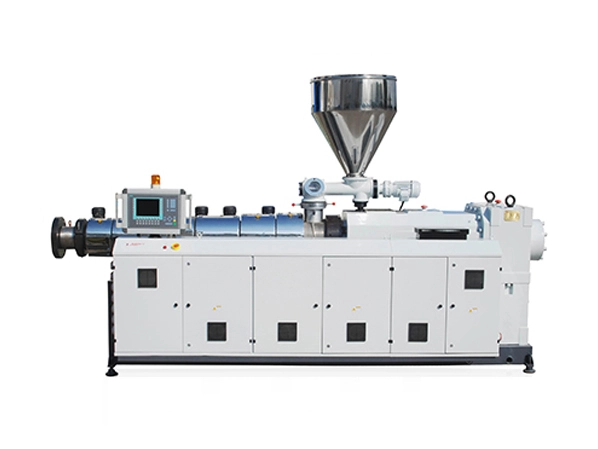
SJ Single Screw Extruder
The XJGMachine SJ series provides several machine sizes for different output requirements. The listed configurations include SJ-45, SJ-65, SJ-75, SJ-90 and SJ-120 models, with different screw diameters, drive power and stated capacity ranges.
View the SJ single-screw extruder and confirm the configuration against your material and production target.
SJ Series Reference Specifications
| Model | L/D ratio | Stated capacity | Screw speed | Power | Center height |
|---|---|---|---|---|---|
| SJ-45 | 25–38:1 | 20–80 kg/h | 120 r/min | 7.5–22 kW | 1000 mm |
| SJ-65 | 25–38:1 | 60–200 kg/h | 120 r/min | 37–55 kW | 1000 mm |
| SJ-75 | 25–38:1 | 120–400 kg/h | 120 r/min | 55–110 kW | 1000 mm |
| SJ-90 | 25–38:1 | 250–600 kg/h | 120 r/min | 55–180 kW | 1200 mm |
| SJ-120 | 25–38:1 | 600–1200 kg/h | 90 r/min | 90–315 kW | 1200 mm |
These are reference specifications for the listed SJ models. Actual output depends on the material, screw configuration, product dimensions, processing conditions and line setup. Confirm the guaranteed production capacity for your specific application before placing an order.
XJGMachine also supplies complete HDPE pipe production lines and PVC pipe production lines. For downstream fabrication, the right equipment may also include a multi-angle pipe cutting machine or an HDPE pipe radius cutter, depending on the finished product and fabrication process.
Before requesting a quotation, prepare your material type, pipe diameter range, wall thickness, target output, required standards, factory utilities and preferred automation level. This gives the manufacturer enough information to recommend a practical line rather than an oversized or incomplete configuration.
Frequently Asked Questions
1. How does an extrusion pipe machine work?
A pipe extrusion machine feeds plastic resin into a heated barrel, where a rotating screw melts, mixes and pressurizes the material. The melt passes through an annular die to form a hollow pipe, which is then sized, cooled, pulled through the line and cut or coiled.
2. What are the main parts of a pipe extrusion line?
The main parts are the material feeding system, extruder, pipe die head, vacuum sizing tank, cooling tanks, haul-off unit and cutting or coiling equipment. A complete line may also include marking, measurement and automatic quality-control systems.
3. What is the difference between a single-screw and twin-screw extruder?
A single-screw extruder uses one rotating screw and is commonly used for PE and HDPE pipe production. A conical twin-screw extruder uses two screws and is commonly selected for rigid PVC processing. The correct choice depends on the resin formulation and required processing conditions.
4. Why does a pipe extrusion line need a vacuum sizing tank?
A vacuum sizing tank helps hold the hot pipe against a calibrated sleeve while cooling begins. This controls the outside diameter and roundness. Vacuum stability, sizing sleeve condition and alignment all affect the final dimensions.
5. What controls the wall thickness of extruded pipe?
Wall thickness is influenced by die and mandrel geometry, melt output, material flow, haul-off speed, calibration and process stability. The relationship between extruder output and line speed is especially important for maintaining consistent pipe weight and dimensions.
6. Can one extrusion pipe machine produce both PE and PVC pipes?
Not automatically. PE and PVC have different processing requirements, and their extruder configurations and tooling may differ. A machine may be adaptable for more than one material only if the screw, barrel, die, feeding system and downstream equipment are suitable for each application.
7. How do I calculate the required pipe extrusion machine capacity?
Start with the pipe material, outside diameter, wall thickness, density, target line speed and planned operating hours. Estimate the required mass output, then confirm that the extruder and downstream equipment can sustain the target under the actual production conditions. Request a material-specific production trial where possible.
8. What causes uneven wall thickness in plastic pipe extrusion?
Common causes include die misalignment, uneven melt distribution, unstable extruder output, inconsistent material feeding and incorrect haul-off speed. Check wall thickness around the pipe circumference and review the die setup and process data before changing operating settings.
9. Is a higher-output pipe extrusion machine always better?
No. A higher-output machine is worthwhile only when the factory can use and sell the additional production. The cooling tanks, haul-off, cutter, utilities and quality-control systems must also support the higher output. Compare saleable production and total operating cost rather than maximum capacity alone.
10. What information should I provide when requesting a pipe extrusion line quotation?
Provide the pipe material, diameter range, wall thickness, target output, product standard, pipe length or coil requirements, factory power supply, available space and automation expectations. These details help the manufacturer recommend the extruder, die, sizing system, cooling tanks and downstream equipment.
References
The following technical and standards resources provide additional background on extrusion equipment, plastic processing and polyethylene pipe requirements. The applicable product standard should always be confirmed for the intended pipe material, market and service conditions.
GF Piping Systems – Planning Fundamentals: Industrial Piping Systems. Technical reference describing extrusion, shaping, calibration, cooling, haul-off and cutting equipment in pipe production.
ISO 4427-1 – Plastics Piping Systems for Water Supply and for Drainage and Sewerage Under Pressure: Polyethylene (PE), Part 1. Standard covering general requirements for PE compounds used in specified pressure-piping applications.
Society of Manufacturing Engineers – Extrusion Processes. Educational reference explaining plastic extrusion, screw and barrel functions, material melting and continuous extrusion operations.