In the industrial piping sector, guessing parameters is a recipe for catastrophic pipeline failure. When contractors or municipal engineers ask about the fusion welding times for HDPE pipes, they are often searching for a simple, universal chart. From our experience engineering and deploying heavy-duty welding machinery at xjgmachine, we must state unequivocally: a single universal time does not exist. The fusion cycle is a precise thermodynamic equation dictated entirely by the pipe's outside diameter (OD), the Standard Dimension Ratio (SDR) or wall thickness, the ambient environmental temperature, and the specific international standard you are operating under (such as ASTM F2620 or ISO 21307).
In most professional situations, a failed weld is rarely caused by the raw high-density polyethylene (HDPE) material. It is almost exclusively the result of operator error—specifically, rushing the heat soak phase or prematurely removing the pipe from the clamps during the cooling cycle to speed up production. To achieve a monolithic joint that is physically stronger than the pipe itself, you must adhere rigidly to the calculated timing parameters. In this uncompromising guide, we will break down the exact mechanical phases of the welding cycle, detail how to calculate your times, and explain why upgrading your operational hardware is mandatory for consistent pipeline integrity.
The total fusion welding times for HDPE pipes are broken into five distinct, non-negotiable phases. While exact seconds vary based on pipe wall thickness, here is the standard operational breakdown:
Initial Bead-Up Time: Time required to press the pipe against the heater plate until a specific bead size forms (varies by diameter, typically 1-3mm).
Heat Soak Time: The critical phase where pressure drops to near zero. Rough calculation: 10 to 15 seconds per millimeter of pipe wall thickness.
Changeover Time: The maximum allowable time to remove the heater plate and bring the pipe ends together. Must be lightning-fast (3 to 8 seconds maximum) to prevent premature cooling.
Pressure Build-Up Time: The time taken to ramp up to the final interfacial welding pressure (usually 3 to 10 seconds).
Cooling Time: The absolute longest phase. The pipe must remain under pressure in the machine clamps. Rough calculation: 1 to 1.5 minutes per millimeter of wall thickness.
We recommend entirely eliminating human error by utilizing a CNC-controlled RHD Butt Welding Machine equipped with an integrated datalogger to automate and record these precise timing cycles.
To accurately calculate the fusion welding times for HDPE pipes, operators must consult the specific tables provided by the pipe manufacturer or the regulatory body governing the project. The two primary schools of thought in the industry are the low-pressure standard (commonly ISO 21307 single low pressure) and the high-pressure standard (commonly ASTM F2620).
The physical wall thickness of the pipe is the absolute dictator of your heat soak and cooling times. A 315mm pipe with an SDR 11 (thick wall) will require significantly longer heat soak and cooling periods than a 315mm pipe with an SDR 17 (thinner wall). The goal is to melt the polymer chains just deep enough so that when the pipes are forced together, the molecular chains entangle completely, forming a continuous, seamless structure.
Before any timing begins, the pipe must be perfectly faced (shaved flat). Using a substandard facer guarantees a failed weld. We mandate the use of precision cutting tools like the DJQ Series HDPE Pipe Band Saw Cutter to ensure absolute squareness. Once faced, the cycle begins:
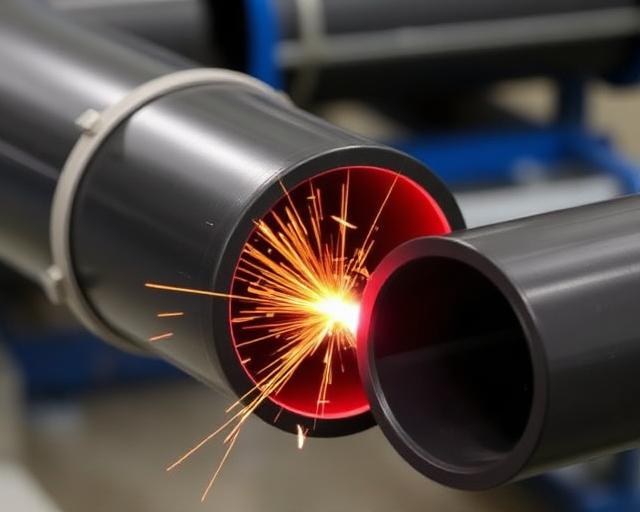
The Heating Plate: The Teflon-coated heating plate is inserted between the pipe ends, typically set between 400°F and 450°F (204°C to 232°C). The pipes are forced against the plate under pressure until a continuous melt bead forms entirely around both pipe circumferences. This is the Bead-Up phase.
The Heat Soak: Once the initial bead forms, the hydraulic pressure must be dropped to "drag pressure" (essentially zero active pressure). This allows the heat to penetrate deeply into the pipe wall without pushing all the molten material out of the weld zone. If you skip this time phase, your weld will have a "cold joint"—it may look fine on the outside but lacks internal molecular entanglement.
The Cooling Phase: After the heater is removed (changeover) and the pipes are forced together under fusion pressure, the joint must remain locked in the machine. In our testing, removing the pipe from the clamps before the core of the wall thickness has dropped below 140°F (60°C) introduces fatal internal stresses. You cannot speed up cooling by pouring water on the joint; this destroys the molecular crystalline structure of the HDPE.
For commercial users handling high-pressure water mains, natural gas distribution, or Dredging Products, the benefit of adhering to strict fusion welding times for HDPE pipes is zero liability. A properly executed butt fusion joint is leak-proof, fully restrained, and will effectively outlast the design life of the pipeline itself (often rated for 50 to 100 years). By utilizing digital timers and dataloggers, contractors can provide municipal inspectors with a printed receipt proving that the heat, soak, and cooling times were executed to the exact millisecond required by code.
We must present practical judgment: laboratory times do not always perfectly translate to a muddy trench in freezing temperatures. The primary limitation of standard time charts is ambient weather.
Cold weather dramatically alters the thermodynamic equation. When welding below freezing, the heater plate temperature generally remains the same, but the pipe will cool significantly faster during the changeover phase. Therefore, changeover time must be aggressively minimized. Furthermore, strong winds act as a heat sink, rapidly cooling the heater plate and the melted pipe ends. In these heavy-duty applications, deploying a protective welding tent or wind shield around the machine is mechanically required, not optional.
For heavy-duty applications and infrastructure contractors: Anyone installing large-diameter HDPE pipelines (160mm to 1600mm) must rely on hydraulically operated, digitally timed butt fusion machines. Manual estimation at these diameters is physically impossible and criminally negligent in high-pressure applications.
For beginners or internal building plumbing: If you are installing small-diameter HDPE pipes (typically 20mm to 110mm) for non-critical indoor water distribution, a massive hydraulic butt fusion rig is overkill. In these scenarios, you should deploy a Socket Fusion Welding Machine. Socket fusion uses different timing parameters entirely, where the pipe is pushed into a heated fitting rather than joined end-to-end, making the process faster and more suitable for tight spaces.
The exterior bead of the weld cools rapidly because it is exposed to ambient air. However, the thick core of the pipe wall remains molten for significantly longer. If an operator touches the outer bead, determines it is cool, and drops the hydraulic clamps, the molten inner core shifts, introducing massive stress fractures into the joint. Always follow the wall-thickness time calculation for cooling, regardless of how the exterior feels.
When you are ready to invest in fusion equipment, you must prioritize machines that remove the guesswork from the fusion welding times for HDPE pipes. Demand machines with separate, dual-channel timers that record both the soaking and cooling phases independently.
Furthermore, ensure the heater plate utilizes a high-grade Teflon (PTFE) coating. If the coating is cheap or degraded, molten plastic will stick to the plate during the critical changeover phase. This delays the changeover time beyond the acceptable 3-8 second window, ruining the entire cycle. For workshop fabrication of complex joints, utilizing a specialized RHJ Multi-Angle Fitting Elbow Welding Machine with integrated digital timing is mandatory for commercial production.
| Pipe Wall Thickness (mm) | Min. Bead Size (mm) | Heat Soak Time (Approx. Seconds) | Max Changeover Time (Seconds) | Min. Cooling Time Under Pressure (Minutes) |
|---|---|---|---|---|
| 4.5mm - 9.0mm | 1.5mm | 45 - 90 seconds | 5 - 6 seconds | 5 - 10 minutes |
| 9.0mm - 18.0mm | 3.0mm | 90 - 180 seconds | 8 - 10 seconds | 10 - 20 minutes |
| 18.0mm - 36.0mm | 5.0mm | 180 - 360 seconds | 12 - 15 seconds | 20 - 45 minutes |
| 36.0mm - 60.0mm+ | 8.0mm+ | 360 - 600+ seconds | 20 seconds max | 45 - 90+ minutes |
| Feature | Manual Hydraulic Fusion Machine | CNC Automated Fusion Machine |
|---|---|---|
| Timing Control | Operator relies on a stopwatch and visual cues. | Computer locks cycle times based on pre-input SDR/Diameter. |
| Pressure Regulation | Operator manually adjusts hydraulic valves during soak. | Sensors automatically drop and ramp pressure instantly. |
| Data Logging | Requires manual written logs (prone to falsification). | Automatic digital receipt generation for inspector sign-off. |
| Best Use Case | Low-budget, non-critical, or agricultural water lines. | Municipal gas, high-pressure water, and strict regulatory zones. |
| Pros (Advantages) | Cons (Limitations) |
|---|---|
| Allows for tapping into existing mainlines without cutting the pipe. | Requires highly specialized heating plates shaped to the pipe radius. |
| Faster overall installation compared to installing full tee fittings. | Timing parameters are highly complex (requires main pipe and fitting to melt simultaneously). |
| Excellent for fabricating reducing tees in a controlled workshop. | Difficult to execute perfectly in a trench without proper alignment tools. |
In most professional situations, the difference between a successful pipeline installation and a catastrophic failure is the precision of your equipment. Relying on outdated hardware with inaccurate gauges guarantees that your fusion welding times for HDPE pipes will be incorrect. We recommend upgrading to purpose-built, highly accurate fabrication machinery.

If you are fabricating reducing tees in a workshop environment, maintaining perfect timing and pressure across a curved saddle joint is exceptionally difficult with manual tools. The xjgmachine Saddle Fusion unit is engineered specifically to automate this precision.
Integrated Fabrication: The integrated function of welding and taping enables the completion of the entire fabricating process in one seamless sequence.
Precision Heat Delivery: Features a high-grade Teflon-coated heating plate to prevent polymer stick during the crucial changeover phase.
Dual-Channel Timing: A separate two-channel timer precisely records the times in both the soaking and cooling phases, eliminating operator guesswork.
Absolute Control: A digital, highly accurate pressure meter indicates exact readings, while linear guide ways stabilize the heating and dragging plates.
Whether you are operating our heavy-duty welding rigs or supplying raw material pipelines through a SJ Single Screw Extruder, controlling the thermodynamic properties of the polymer is the core of our engineering philosophy.
Absolutely not. Pouring water, applying wet rags, or using compressed air to rapidly cool an HDPE fusion joint will shock the polymer. This rapid cooling destroys the semi-crystalline molecular structure of the plastic, creating massive internal stress fractures that will cause the joint to fail under operational pressure. The pipe must cool naturally under pressure in ambient air.
The changeover time is the window between removing the heater plate and joining the pipe ends together. If this takes longer than the allowed maximum (usually 3 to 10 seconds depending on pipe size), the molten faces of the pipe will begin to cool and form a semi-solid skin. When forced together, these cooled faces will not mix molecularly, resulting in a "cold joint" that possesses virtually zero tensile strength.
Generally, the heating and cooling times are driven by the physical wall thickness of the pipe, not necessarily the resin grade. Both PE80 and PE100 typically use the same heater plate temperature (400°F - 450°F). However, you must always consult the pipe manufacturer's specific technical data sheet, as highly specialized proprietary resins may require slight adjustments to the interfacial pressure or heat soak times.
To ensure our fusion welding guidelines align with global pipeline safety and engineering standards, we reference data from the following authorities:
Plastics Pipe Institute (PPI): The premier North American trade association representing the plastic pipe industry, providing the definitive TR-33 document on generic butt fusion procedures for HDPE. Visit PPI
ASTM International: The globally recognized organization developing the ASTM F2620 standard practice, which dictates the exact pressures, temperatures, and times for heat fusion joining of polyethylene pipe and fittings. Visit ASTM International
International Organization for Standardization (ISO): Defining the ISO 21307 standard, providing the operational parameters for single low-pressure, dual low-pressure, and single high-pressure fusion jointing. Visit ISO Standards


 English
 العربية
 русский
 Español
 français
 português
 Deutsch
 italiano
 Türkçe
 한국어
한국어 日本語
日本語