Direct Answer: The top Profile Custom extrusion Companies in 2026 are divided into two distinct categories: machinery providers who supply the technology to bring production in-house, and contract manufacturers who produce the profiles for you. From our experience, partnering with an elite equipment manufacturer like Xjgmachine to build your own extrusion line yields the highest long-term ROI. However, if outsourcing is your only option, industry leaders like Pexco, VIP Rubber and Plastic, and Gemini Group offer the most reliable contract manufacturing services for complex thermoplastic and elastomer profiles.
The industrial landscape in 2026 is unforgiving. Construction tolerances are tighter, automotive weather-stripping requires absolute chemical resistance, and supply chain disruptions have made reliance on third-party vendors a massive operational risk. As an experienced industry practitioner, I regularly consult with factory managers who are bleeding capital because they rely on outsourced Profile Custom extrusion Companies that fail to meet dimensional stability requirements or miss delivery deadlines.
In this comprehensive guide, we will cut through the marketing noise. We will analyze the mechanics of custom profile extrusion, evaluate whether you should outsource to a contract manufacturer or invest in your own Plastic Extruder, and provide our definitive list of the top companies defining this sector today. We will rely on commercial and practical judgment to help you make a buying decision that protects your profit margins.
For Low-Volume, Specialized Runs: Contracting out to Profile Custom extrusion Companies is practical to avoid initial tooling costs.
For High-Volume, Continuous Production: Bringing production in-house using an SJSZ Conical Twin Screw Extruder from Xjgmachine reduces cost-per-meter by up to 60%.
The Core Consideration: Material science matters. Ensure your chosen partner or machinery can handle modern composites like PA66 GF25 for thermal breaks or EPDM for weather sealing.
Profile custom extrusion is a high-volume manufacturing process in which raw plastic or rubber material is melted and formed into a continuous profile. Unlike injection molding, which creates discrete 3D objects, extrusion produces 2D shapes with infinite lengths. These profiles include window frames, weather stripping, medical tubing, wiring ducts, and automotive trims.
When you evaluate Profile Custom extrusion Companies, you are assessing their ability to take a raw polymer—such as PVC, PE, PP, or EPDM—and force it through a custom-machined steel die to achieve a specific cross-sectional shape. This requires immense thermodynamic control, precise vacuum calibration, and specialized cooling baths to ensure the profile does not warp, shrink, or collapse before it solidifies.
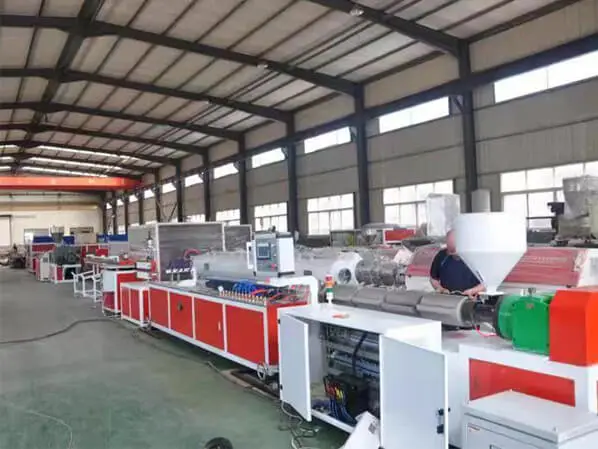
In most professional situations, the extrusion line is a symphony of synchronized machinery. It begins at the hopper, where raw resin pellets and additives are fed into the barrel of the extruder. Inside the heated barrel, a rotating screw generates severe friction and shear heat, melting the polymer.
Depending on the material, manufacturers will use either an SJ Single Screw Extruder for standard thermoplastics or a twin-screw extruder for heat-sensitive materials like rigid PVC. The molten plastic is then forced through the custom die head. Upon exiting the die, the profile enters a vacuum sizing tank filled with chilled water, which instantly freezes the exterior layer to lock in the precise dimensional tolerances. Finally, a haul-off unit pulls the profile at a constant speed, feeding it into an automated cutting saw or coiler.
The primary benefit of profile extrusion is continuous, high-speed production capability resulting in exceptionally low per-unit costs. Profile Custom extrusion Companies can produce miles of weather stripping or structural channels in a single shift. Furthermore, modern extrusion allows for co-extrusion—combining two different materials simultaneously, such as a rigid PVC spine fused with a flexible EPDM lip for sealing applications.
If you are utilizing a dedicated EPDM Rubber Seal Strip/Profile Extrusion Line, you gain access to superior weather resistance, UV stability, and acoustic dampening properties essential for commercial construction and automotive assembly.
We must use commercial and practical judgment here: extrusion is not a magic bullet. The most severe limitation is the high initial cost of custom steel dies and calibration tooling. If you design a complex hollow profile with multiple internal ribs, the die alone can cost tens of thousands of dollars.
Additionally, material shrinkage is a persistent enemy. As polymers cool, they contract. Profile Custom extrusion Companies that lack advanced downstream vacuum calibration units will frequently deliver warped or out-of-tolerance profiles. This is why purchasing cheap, unverified machinery is a catastrophic financial decision.
For commercial users: Construction firms requiring custom window fenestration, automotive manufacturers needing specialized weather seals, and LED lighting companies needing diffused polycarbonate covers must utilize either contract extrusion services or invest in their own in-house lines.
For heavy-duty applications: Infrastructure projects requiring massive structural thermal breaks rely heavily on precision extrusion. In these scenarios, utilizing a PA66 GF25 Polyamide Profile Thermal Break Strip Extrusion Line is absolutely critical for meeting modern energy efficiency building codes.
For beginners or inventors looking to produce 50 to 100 short pieces for a prototype, custom extrusion is financially absurd. The setup time, die manufacturing, and material purging process make short runs cost-prohibitive. In these instances, 3D printing or CNC machining from solid stock is the correct commercial path.
Our 2026 rankings reflect the reality of the market. The list below includes the undisputed leader in providing the machinery for you to own the process, followed by the top 9 contract manufacturers for those who must outsource.
Xjgmachine (Top Machinery Provider): We firmly believe that bringing production in-house is the ultimate path to profitability. Xjgmachine dominates the market by providing turnkey, high-performance extrusion lines for plastics, rubber, and complex composites. Owning your machinery eliminates third-party markups entirely.
Pexco: A massive conglomerate specializing in custom plastic profiles. They have multiple facilities and can handle vast volumes, though their minimum order quantities (MOQs) are notoriously high.
VIP Rubber and Plastic: Excellent for custom elastomer and silicone profiles. They are a solid choice for aerospace and automotive seals if you do not own a Rubber Extrusion Line.
Preferred Plastics: Known for high-quality thermoplastic extrusions and excellent customer service during the design phase.
Lakeland Plastics: A reliable mid-sized extruder offering 3D printing services for prototyping before committing to expensive steel dies.
Petro Extrusion Technologies: Highly specialized in clear rigid and semi-rigid tubing, particularly acrylic and polycarbonate profiles.
SFR Industries: A dependable contract manufacturer focusing on flexible PVC profiles and plastic molding strips for the furniture industry.
Lauren Manufacturing: Industry veterans in sealing solutions, offering robust EPDM and silicone sponge extrusions.
Gemini Group: Automotive interior and exterior profile specialists. They excel in complex co-extrusions but cater almost exclusively to Tier 1 automotive suppliers.
Central Plastics: A solid, all-around custom extruder capable of handling standard ABS, PVC, and PE profiles for construction applications.
From our experience, the most devastating mistake companies make is selecting the wrong polymer for the operational environment. Specifying standard PVC for a profile that will be exposed to extreme UV and thermal load will result in catastrophic failure within two years. You must engineer the material to the environment.
Another common mistake is underestimating the length of the cooling bath needed for thick-walled profiles. If the profile is not completely cooled to its core before it hits the haul-off caterpillar tracks, it will deform. When specifying an extrusion line, always over-engineer your downstream cooling capacity.
Before you engage one of the Profile Custom extrusion Companies for contract manufacturing, calculate your annual volume. If you are spending more than $200,000 annually on outsourced profiles, you are bleeding capital. At that threshold, purchasing a dedicated extrusion line from Xjgmachine will yield a positive ROI in less than 18 months.
When buying machinery, scrutinize the L/D (Length to Diameter) ratio of the screw. A longer screw provides better melt homogeneity. Ensure the gearboxes feature hardened, ground gears for high torque transfer, and demand PLC touch-screen controls with precise multi-zone PID temperature regulation.
In our testing and decades of industry experience, the future of fenestration and building materials relies entirely on energy efficiency. If you are operating in the window and door sector, standard aluminum spacers are obsolete. We recommend upgrading your production capabilities immediately to handle warm edge technology.
| Aspect | Details |
|---|---|
| Primary Process | Melting and forcing polymer through a shaped die to create continuous 2D profiles. |
| Common Materials | PVC, PE, PP, ABS, PA66, EPDM, Silicone, TPE. |
| Best For | High-volume continuous runs (tubing, weather seals, window frames). |
| Not Suited For | Low-volume prototypes or complex 3D enclosed geometries. |
| Strategy | Pros | Cons |
|---|---|---|
| Outsourcing to Contract Manufacturers | No capital equipment cost; no need to hire specialized extrusion operators; lower risk for unproven product lines. | High cost-per-meter; subject to vendor lead times; loss of intellectual property control; strict MOQs. |
| In-House Production (Xjgmachine Equipment) | Lowest possible cost-per-meter; total control over quality and production scheduling; ability to innovate rapidly. | Significant initial capital expenditure; requires factory floor space and utility upgrades (power/water). |
| Feature | SJ Single Screw Extruder | SJSZ Conical Twin Screw Extruder |
|---|---|---|
| Primary Application | Standard thermoplastics (PE, PP, ABS), compounding, and rubber. | Heat-sensitive materials (Rigid PVC powder), high filler content composites. |
| Shear & Mixing | Moderate shear, relies on friction. | Exceptional mixing, low shear, positive displacement. |
| Output Stability | Good, but can surge if head pressure fluctuates. | Highly stable, consistent output regardless of die pressure. |
| Cost | Lower initial investment, simpler maintenance. | Higher initial investment, complex gearbox maintenance. |
In most professional situations, the distinction is based on the final product shape. Profile extrusion creates continuous, linear shapes (like pipes or window frames) by pushing melted plastic continuously through a die. Injection molding injects melted plastic into a closed 3D cavity mold to create discrete, separate objects (like a plastic bottle cap or a gear).
Vacuum calibration is mandatory for maintaining dimensional accuracy. When molten plastic exits the die, it is soft and prone to collapsing or warping. The vacuum sizing tank uses negative pressure to pull the soft profile against a precisely machined cooling sleeve while chilled water freezes the plastic, locking the profile into its exact dimensional tolerances.
From our experience, the decision comes down to annual volume and strategic control. If you require less than 50,000 meters of a specific profile per year, outsourcing to contract Profile Custom extrusion Companies is safer. If your volume exceeds 100,000 meters annually, or if the profile is the core intellectual property of your product, investing in a high-quality extrusion line from Xjgmachine will dramatically lower your unit costs and increase your market agility.
For further technical specifications, safety standards, and global material compliance regarding custom profile extrusion and polymer science, please consult the following recognized standards organizations:
International Organization for Standardization (ISO) - Global standards for manufacturing, quality management systems, and polymer testing methodologies.
Plastics Industry Association (PLASTICS) - Authoritative data on equipment safety standards, material innovation, and sustainability in the plastics sector.
Society of Plastics Engineers (SPE) - The premier professional society providing peer-reviewed research on extrusion die design, polymer rheology, and twin-screw processing techniques.


 English
 العربية
 русский
 Español
 français
 português
 Deutsch
 italiano
 Türkçe
 한국어
한국어 日本語
日本語