English
 العربية
 русский
 Español
 français
 português
 Deutsch
 italiano
 Türkçe
 한국어
 日本語

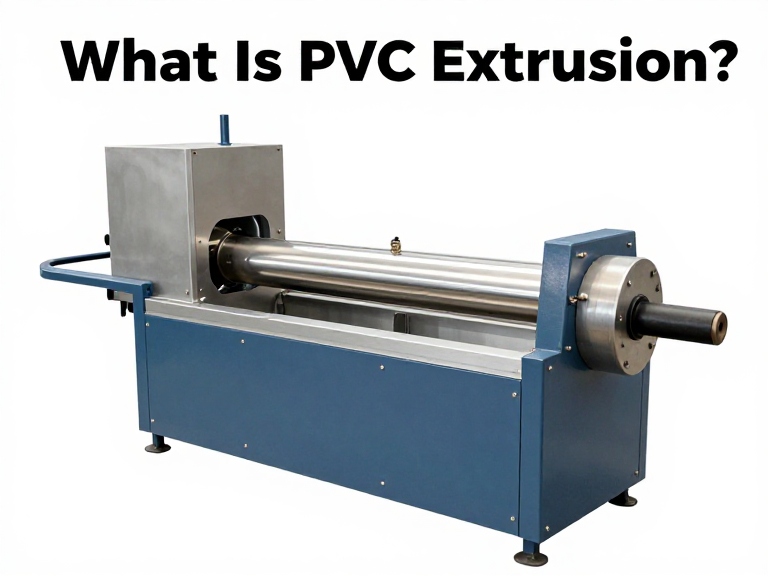
PVC extrusion is a continuous manufacturing process that turns polyvinyl chloride compound into pipes, profiles, tubes, sheets, and other consistent plastic products. For manufacturers, the important question is not simply how the process works. It is whether the extrusion line, screw configuration, temperature control, and downstream equipment are matched to the PVC formulation and finished product. A mismatch can create unstable output, poor dimensions, surface defects, and unnecessary operating costs.
Quick Answer: What Is PVC Extrusion?
PVC extrusion is a process in which prepared PVC material is heated, plasticized, mixed, and pushed through a shaped die by an extruder. The material leaves the die as a continuous profile, pipe, or other product, then passes through calibration, cooling, pulling, and cutting equipment.
It is widely used to manufacture PVC water and drainage pipes, electrical conduits, window and door profiles, cable trunking, and specialist plastic components. For most rigid PVC pipe and profile applications, a properly configured conical twin screw extruder is a practical choice because it supports controlled feeding, mixing, and processing of heat-sensitive PVC compounds.
Our recommendation: Select the complete production line around the product specification and target output—not around extruder price or advertised capacity alone.
1. What Is PVC Extrusion?
PVC extrusion is a thermoplastic processing method used to produce long products with a consistent cross-sectional shape. PVC stands for polyvinyl chloride, a widely used polymer available in different formulations. Depending on the application, manufacturers process rigid PVC (often called uPVC) or flexible PVC containing suitable plasticizers.
Unlike injection molding, which fills a closed mold to make individual parts, extrusion produces a continuous length of material through a die. The die determines the product's cross-sectional geometry. Downstream equipment then stabilizes, cools, pulls, and cuts the extrudate to the required dimensions.
Rigid PVC and Flexible PVC Are Not Interchangeable
Rigid PVC is commonly used for pipes, window profiles, conduits, and construction components where dimensional stability and stiffness matter. Flexible PVC is used for applications such as flexible tubing, cable insulation, and certain seals. The formulation, processing window, screw design, and cooling requirements can differ significantly.
In most professional situations, the first specification to confirm is the exact PVC compound—not the machine model. A line designed for rigid pipe should not be assumed to process every flexible PVC formulation efficiently without checking its configuration.
2. How Does the PVC Extrusion Process Work?
A PVC extrusion line operates continuously. Each stage affects the quality of the next one, so a stable process depends on coordinated equipment rather than the extruder working in isolation.
Step 1: PVC Material Preparation and Mixing
PVC resin is combined with formulation ingredients selected for the intended application. These may include heat stabilizers, lubricants, processing aids, impact modifiers, pigments, fillers, and plasticizers where required. The exact recipe depends on the product's mechanical, thermal, dimensional, color, and regulatory requirements.
Consistent batching is essential. Variation in additive dosage or mixing quality can lead to inconsistent fusion, color differences, surface defects, and changes in mechanical performance. For commercial users, material traceability and repeatable mixing procedures are worth investing in before increasing line speed.
Step 2: Feeding the Extruder
The prepared compound is transferred into the extruder hopper. Feeding equipment must deliver material steadily. Poor feeding can cause output fluctuations, unstable pressure, and inconsistent product dimensions. Depending on the formulation and production setup, the line may use automatic conveying, metering, or feeding systems.
Step 3: Heating, Plasticizing, and Mixing
Inside the extruder barrel, rotating screws convey and work the material. Heat comes from controlled barrel heating and the mechanical energy generated during processing. The objective is to achieve suitable plasticization and material homogeneity while avoiding excessive heat exposure.
PVC requires careful thermal management. Excessive processing temperature or long residence time can contribute to degradation, discoloration, and other quality problems. Operators should use a validated processing window for the actual compound instead of copying temperature settings from another factory or material supplier.
Step 4: Shaping Through the Die
The processed PVC compound is forced through a die that forms the required cross-section. Pipe dies, profile dies, and sheet dies have different flow paths and tooling requirements. Die design, flow balance, and temperature uniformity influence wall thickness, dimensional consistency, and surface appearance.
Step 5: Calibration and Cooling
After leaving the die, the product must retain its shape while cooling. PVC pipe lines commonly use vacuum calibration and cooling tanks. Profiles may use calibration tables and specialized cooling arrangements. Cooling that is too slow can limit production speed, while uneven or overly aggressive cooling may contribute to deformation or residual stress.
Step 6: Haul-Off and Cutting
A haul-off unit pulls the product through the downstream equipment at a controlled speed. The pulling speed must match the extrusion output. If the haul-off runs too fast or too slowly, dimensions and wall thickness may change. A cutting unit then cuts the continuous product to the specified length. Pipe lines may include additional handling or socket-forming equipment depending on the final product.
3. What Machines Are Used in PVC Extrusion?
A complete PVC extrusion system includes more than the main extruder. The required configuration depends on the product, material formulation, output target, and factory layout.
PVC extruder: Plasticizes and conveys the compound through the die. Screw design and drive capacity should match the material and output requirement.
Feeding and conveying system: Transfers raw material and compound to the extruder consistently.
Die and tooling: Forms the product's cross-section and controls material flow.
Vacuum calibration and cooling equipment: Stabilizes dimensions and removes heat.
Haul-off unit: Pulls the product at a controlled speed.
Cutting machine: Cuts pipes or profiles to the required length.
Control system: Monitors and adjusts operating parameters such as temperature, speed, and production settings.
Auxiliary equipment: May include mixers, crushers, powder feeders, printers, belling machines, and handling systems.
For a broader equipment overview, review the plastic extruder range and compare the configuration with the intended PVC product. The main machine should be selected as part of a complete line plan.
4. What Products Can PVC Extrusion Manufacture?
PVC extrusion is used across construction, infrastructure, electrical, and industrial markets. Its commercial value comes from the ability to produce long, repeatable products in a continuous process.
PVC Pipes and Tubes
PVC pipe is used in water distribution, drainage, irrigation, conduit, and other piping applications where the relevant product standards and local codes permit its use. Pipe production requires close control of outside diameter, wall thickness, roundness, length, and material performance.
For manufacturers entering this market, a dedicated PVC pipe production line is generally a more suitable starting point than adapting a general-purpose extruder without checking calibration and downstream requirements. Higher-volume operations may also compare a PVC double pipe production line or a four-output PVC pipe line, provided the product sizes and demand justify multiple output channels.
Window and Door Profiles
Rigid PVC profiles are used in window and door systems, trims, and building components. These products can have complex hollow cross-sections, so die design, calibration, cooling, and dimensional inspection are particularly important.
Electrical Conduits and Cable Management
PVC extrusion can produce conduits, trunking, and protective channels for electrical installations. The required stiffness, impact resistance, flame performance, and dimensional tolerances depend on the application and applicable standards.
Specialty Profiles and Composite Products
PVC can also be processed into custom profiles and certain wood-plastic composite products. These applications may need different screw configurations, tooling, and process settings. A PVC/WPC pelletizing line serves a different production purpose from a finished-profile extrusion line, so buyers should distinguish compounding or pelletizing equipment from equipment that directly forms the final product.
5. Benefits and Limitations of PVC Extrusion
Why Manufacturers Use PVC Extrusion
Continuous production: Long pipes and profiles can be manufactured without producing each piece in a separate molding cycle.
Repeatable cross-sections: A suitable die and stable process can produce consistent product geometry over long production runs.
Flexible product design: Different dies and formulations allow manufacturers to serve several product categories.
Scalable output: Production capacity can be increased through line selection, process optimization, or additional equipment.
Established processing technology: PVC extrusion is widely used in construction and infrastructure manufacturing, with established equipment and quality-control practices.
Limitations Buyers Should Understand
Thermal sensitivity: PVC can degrade if processing conditions are not properly controlled.
Tooling dependence: A new product geometry may require a new die and calibration tooling, adding cost and setup time.
Process interaction: Extruder output, cooling, haul-off, and cutting must be coordinated.
Formulation dependence: A machine's performance with one compound does not guarantee identical results with another.
Quality obligations: Product testing, traceability, and applicable standards remain the manufacturer's responsibility.
We recommend PVC extrusion when the target product has a continuous profile and sufficient production demand. It is not automatically the best method for short, complex, three-dimensional parts that are more economically produced by injection molding or another process.
6. PVC Extrusion Machine Comparison: Which Type Should You Choose?
The right extruder depends on the PVC formulation, product geometry, required output, and production conditions. The following comparison is a starting point for equipment selection, not a substitute for a technical review of the actual compound.
| Machine type | Typical application | Potential advantages | Key buying consideration |
|---|---|---|---|
| Conical twin screw extruder | Rigid PVC pipes, profiles, and related products | Designed for PVC processing; supports feeding, conveying, and mixing | Confirm screw geometry, motor capacity, output at the target formulation, and thermal control |
| Parallel twin screw extruder | Selected PVC compounding and extrusion applications | Can be configured for particular mixing and processing requirements | Check whether the configuration suits the formulation and production task |
| Single screw extruder | Many general thermoplastic extrusion applications | Relatively straightforward operating concept and broad application range | Do not assume a standard single screw design is suitable for every rigid PVC compound |
| Dedicated pipe extrusion line | PVC pipe manufacturing | Integrates extrusion with pipe die, calibration, cooling, haul-off, and cutting | Match pipe diameter range, wall thickness, standards, and target output |
For rigid PVC pipe and profile production, we generally advise buyers to evaluate a purpose-configured SJSZ conical twin screw extruder. A SJ single screw extruder may be appropriate for other materials and applications, but it should not be selected for PVC solely because its purchase price is lower.
7. PVC Extrusion: Pros and Cons
| Pros | Cons |
|---|---|
| Efficient for continuous production of pipes and profiles | Requires stable process control and trained operators |
| Can produce consistent cross-sectional geometry | Tooling changes can add cost when product designs change |
| Supports a wide range of rigid and flexible PVC products | Different formulations may require different process settings |
| Can be integrated with automated feeding and downstream handling | Line integration and factory layout require careful planning |
| Suitable for scaling production when demand is established | Overestimating demand can leave expensive equipment underused |
In our view, the strongest advantage is repeatable, continuous production—not simply high nominal output. A line that produces more kilograms per hour but generates excessive scrap or inconsistent dimensions may have a higher cost per accepted meter than a slower, stable line.
8. Seven Key Factors to Consider Before Buying PVC Extrusion Equipment
1. Define the Finished Product Precisely
Start with the product drawing and specification. Identify the material grade, cross-section, diameter or profile dimensions, wall thickness, tolerance, color, surface finish, and required length. For pipes, specify the diameter range and applicable pressure or dimensional class. For profiles, provide a detailed cross-section drawing and identify critical dimensions.
A supplier cannot responsibly recommend the right line based only on a general request for a PVC extruder. We recommend sharing product drawings and samples before finalizing a machine configuration.
2. Confirm the PVC Formulation
Rigid PVC, flexible PVC, recycled PVC blends, and PVC compounds with different fillers or modifiers can behave differently during processing. Ask the equipment supplier to review the actual formulation or a representative material sample. Confirm whether the line requires special feeding, screw, venting, or temperature-control arrangements.
3. Calculate Realistic Production Capacity
Do not base your investment on a maximum output figure without understanding its test conditions. Ask how the supplier defines output: which material, product size, wall thickness, screw speed, and quality criteria were used? A large-diameter pipe may have a very different production rate from a small conduit.
For commercial users, calculate expected saleable output per shift, planned operating hours, changeover time, maintenance downtime, and scrap. The capacity that matters is consistent good product, not a headline number.
4. Evaluate Screw and Barrel Design
The screw and barrel are central to conveying, plasticizing, and mixing. Their design must match the PVC compound and production objective. Ask about screw geometry, material selection, wear resistance, surface treatment, and maintenance requirements. For abrasive or heavily filled formulations, wear considerations become particularly important.
5. Check Temperature Control and Process Stability
Reliable heating, cooling, and temperature monitoring help operators maintain a stable processing window. Ask how the machine controls barrel zones, screw speed, melt pressure where applicable, and alarms. Confirm whether operators can access useful process data and repeat settings for future production batches.
6. Inspect the Complete Downstream Line
Do not evaluate the extruder separately from the die, calibration system, cooling tanks, haul-off, and cutter. These components determine whether the line can maintain the required dimensions at the intended speed. Pipe manufacturers should also consider whether they need a PVC pipe belling machine for socket forming, or a PVC pipe bending machine for a specific downstream operation.
7. Compare Technical Support and Lifecycle Cost
Purchase price is only one part of the investment. Evaluate installation, commissioning, operator training, spare parts, maintenance access, warranty terms, remote support, and response time. Ask which wear parts should be stocked locally and what routine maintenance is expected.
From our experience, a supplier who can explain the complete process and support the line after delivery is often a better long-term choice than a supplier competing only on initial machine price.
9. Common PVC Extrusion Mistakes and How to Avoid Them
Choosing a machine by price alone: A low initial price may conceal inadequate output, unsuitable screw design, or missing downstream equipment. Compare complete technical configurations.
Using one temperature recipe for every compound: Formulations differ. Establish processing parameters through controlled trials and material supplier guidance.
Ignoring die and calibration design: The extruder cannot compensate for poorly designed tooling or unstable calibration.
Running the haul-off without matching output: Pulling speed and extrusion output must be coordinated to protect dimensions and wall thickness.
Overlooking raw material consistency: Changes in resin, additives, moisture, or recycled content can affect process stability and final product quality.
Buying excessive capacity too early: An oversized line can increase capital, energy, and staffing costs without creating additional sales.
Skipping product testing: Visual inspection alone cannot confirm that a pipe or profile meets its mechanical and dimensional specification.
For beginners, the best safeguard is a written technical specification and a factory acceptance test based on representative material and product dimensions. For established manufacturers, process data and regular quality checks are essential for reducing variation across shifts.
10. How to Choose a PVC Extrusion Line Manufacturer
Choosing a manufacturer is a technical and commercial decision. A reliable supplier should be able to discuss the finished product, material formulation, target capacity, line layout, and expected operating conditions—not just provide a catalogue and price quotation.
Questions to Ask Before Ordering
Can you recommend a line based on our product drawings and PVC formulation?
What output can you demonstrate for our actual product size and material?
Which extruder, die, calibration, cooling, haul-off, and cutting units are included?
What utilities, floor space, and auxiliary equipment are required?
Can you provide a layout drawing and a detailed technical configuration?
What installation, commissioning, training, warranty, and spare-parts support do you provide?
Can we inspect a similar operating line or review a production test?
Ask for a quotation that separates the main machine, tooling, auxiliary equipment, control system, installation scope, and optional items. This makes supplier comparisons more meaningful and reduces the risk of discovering essential omissions after the order is placed.
Xjgmachine supplies plastic processing equipment for applications ranging from compounding to finished-product extrusion. When evaluating a plastic extruder, buyers should provide their product requirements so the equipment configuration can be assessed against real production conditions.
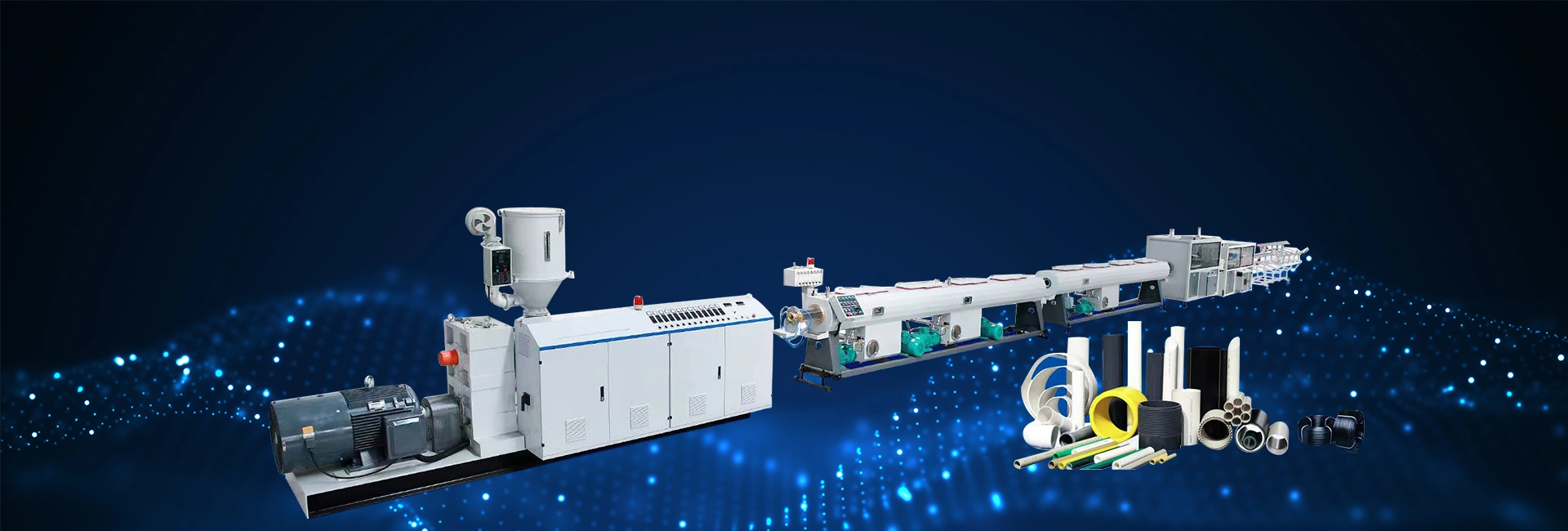
Xjgmachine Plastic Pipe Production Line
Xjgmachine offers a range of plastic processing equipment designed for applications from compounding to thermoforming. Its equipment portfolio emphasizes durability, efficiency, and user-friendly operation for modern plastic production requirements.
For manufacturers planning PVC pipe production, review the line configuration, product range, target output, and downstream equipment before choosing a model.
11. PVC Extrusion Line Cost: What Determines the Investment?
There is no meaningful universal price for a PVC extrusion line. The investment depends on the product, production capacity, machine configuration, tooling, automation level, and installation scope. A small pipe line and a high-output multi-size production system are not comparable purchases.
Main Cost Drivers
Extruder configuration: Screw type, diameter, drive power, and control specification affect the main machine cost.
Product tooling: Dies, calibration sleeves, sizing tools, and product-specific components can represent a significant part of the investment.
Downstream equipment: Cooling tanks, haul-off units, cutters, stackers, and belling systems add to the complete line cost.
Automation: Automatic feeding, centralized control, measurement, and handling can reduce manual work but increase initial investment.
Installation and service: Freight, commissioning, training, and spare parts should be included in the total project budget.
How to Assess Cost-Benefit
Compare the expected cost per accepted product unit rather than the purchase price alone. Include raw material consumption, energy, labor, scrap, maintenance, tooling changes, and realistic utilization. If a more expensive line reduces waste, improves uptime, or enables a higher-value product, it may offer a better return. If demand is uncertain, a modular configuration or staged capacity expansion may be financially safer.
We recommend asking each supplier to quote the same product specification and list all included equipment. Without a common technical baseline, a low quotation may simply exclude components that another supplier has included.
12. Who Should Use PVC Extrusion—and Who May Not Need It?
Best Use Cases
Pipe manufacturers: Companies producing PVC water, drainage, irrigation, or conduit pipes at recurring volumes.
Building-material producers: Manufacturers making window profiles, trims, channels, and other continuous PVC components.
Industrial profile suppliers: Businesses producing custom cross-sections for OEM or industrial customers.
Established plastic processors: Factories expanding their product range or replacing outdated extrusion equipment.
Who May Not Need a PVC Extrusion Line?
A business with low or unpredictable demand may be better served by outsourcing production until sales volume is established. Companies making discrete, complex parts may find injection molding more appropriate. Manufacturers whose products require a different polymer should not choose PVC extrusion simply because the machinery appears similar.
For heavy-duty applications, the decision should be based on product performance requirements, compound suitability, applicable standards, and process validation—not on the assumption that PVC is suitable for every environment.
13. Quick Summary: PVC Extrusion at a Glance
| Topic | Key information | Practical recommendation |
|---|---|---|
| Definition | Continuous process that pushes plasticized PVC through a shaped die | Start with the finished product specification |
| Main stages | Mixing, feeding, plasticizing, die forming, calibration, cooling, haul-off, cutting | Evaluate the complete production line |
| Common products | Pipes, conduits, profiles, tubes, and specialty sections | Choose tooling and downstream equipment for the exact product |
| Common extruder | Conical twin screw extruder for many rigid PVC applications | Confirm suitability with the actual compound and output target |
| Main process risk | Thermal degradation and unstable dimensions | Control temperature, residence time, output, and cooling |
| Purchase priority | Product quality, stable output, line integration, service support | Compare technical scope and lifecycle cost—not price alone |
| Best investment approach | Capacity matched to realistic demand | Calculate saleable output and expected utilization |
14. Expert Recommendation: Is PVC Extrusion Worth Investing In?
PVC extrusion is worth investing in when you have a defined product, repeatable demand, and a production plan that benefits from continuous manufacturing. It is particularly compelling for pipe and profile businesses that need consistent cross-sections and regular output.
However, buying the largest machine or the lowest-priced line is rarely the right strategy. The better investment is a properly matched system: suitable screw configuration, reliable temperature control, correctly designed tooling, effective calibration and cooling, and downstream equipment that can keep pace with the extruder.
For beginners, we recommend starting with a clear product specification, realistic capacity target, and a complete line quotation. For commercial users upgrading an existing factory, compare current scrap rates, downtime, energy use, labor requirements, and actual saleable output against the proposed new line. An upgrade is justified when it solves a measurable production constraint or opens a profitable product opportunity.
Before placing an order with Xjgmachine or another equipment supplier, provide product drawings, material details, target dimensions, and expected output. Request a technical proposal that explains the configuration and confirms what is included. This is the most practical way to reduce equipment-selection risk and build a PVC extrusion operation around production results rather than assumptions.
15. Frequently Asked Questions About PVC Extrusion
1. What is PVC extrusion in simple terms?
PVC extrusion is a manufacturing process that heats and plasticizes PVC compound, pushes it through a shaped die, and cools the continuous product into pipes, profiles, tubes, or other forms.
2. What is PVC extrusion used for?
Common applications include water and drainage pipes, electrical conduits, window and door profiles, cable channels, trims, and custom industrial profiles. The appropriate application depends on the PVC formulation and product requirements.
3. Which extruder is best for PVC?
A conical twin screw extruder is commonly selected for rigid PVC pipe and profile production. The best configuration still depends on the compound, product geometry, required output, and downstream equipment. Buyers should request a recommendation based on their actual material and product specification.
4. What is the difference between a single screw and twin screw extruder?
They use different screw arrangements and can offer different conveying, mixing, and processing characteristics. Twin screw configurations are widely used for many PVC applications, while single screw extruders are common across numerous other thermoplastic processes. Selection should be application-specific.
5. What is the difference between rigid PVC and flexible PVC extrusion?
Rigid PVC is formulated for stiffness and dimensional stability, while flexible PVC contains plasticizers to achieve greater flexibility. Their material behavior and processing requirements differ, so the machine configuration and process settings must suit the formulation.
6. What are the main stages of PVC pipe extrusion?
The main stages are compound preparation, feeding, plasticizing, die forming, vacuum calibration, cooling, haul-off, and cutting. Some products also require printing, socket forming, or additional handling.
7. Why does PVC extrusion require careful temperature control?
PVC is sensitive to excessive heat exposure. Poorly controlled temperature or residence time can contribute to degradation, discoloration, and reduced product quality. Operators should establish suitable settings for the specific compound and machine.
8. How do I choose the right PVC extrusion line?
Define the product dimensions, formulation, output target, tolerance, and applicable standards first. Then evaluate the extruder, die, calibration, cooling, haul-off, cutter, automation, installation, and after-sales support as one integrated system.
9. Is PVC extrusion suitable for small manufacturers?
It can be, if demand and expected utilization justify the investment. Smaller manufacturers should compare equipment ownership costs with outsourcing and avoid buying more capacity than they can use profitably.
10. What should I provide when requesting a PVC extrusion machine quotation?
Provide product drawings or samples, material formulation or grade, dimensions, wall thickness, tolerances, target output, required standards, factory utilities, and preferred automation level. These details help suppliers propose a suitable configuration and a more comparable quotation.
References
The following technical and standards resources are useful starting points when defining PVC pipe requirements and evaluating production quality. Always confirm the current edition and the exact standard applicable in your target market.
Standards and product requirements vary by application and destination market. This article is general manufacturing guidance, not a substitute for product testing, engineering validation, or regulatory review.